
One Patient Told Her Story Seven Times in One Year
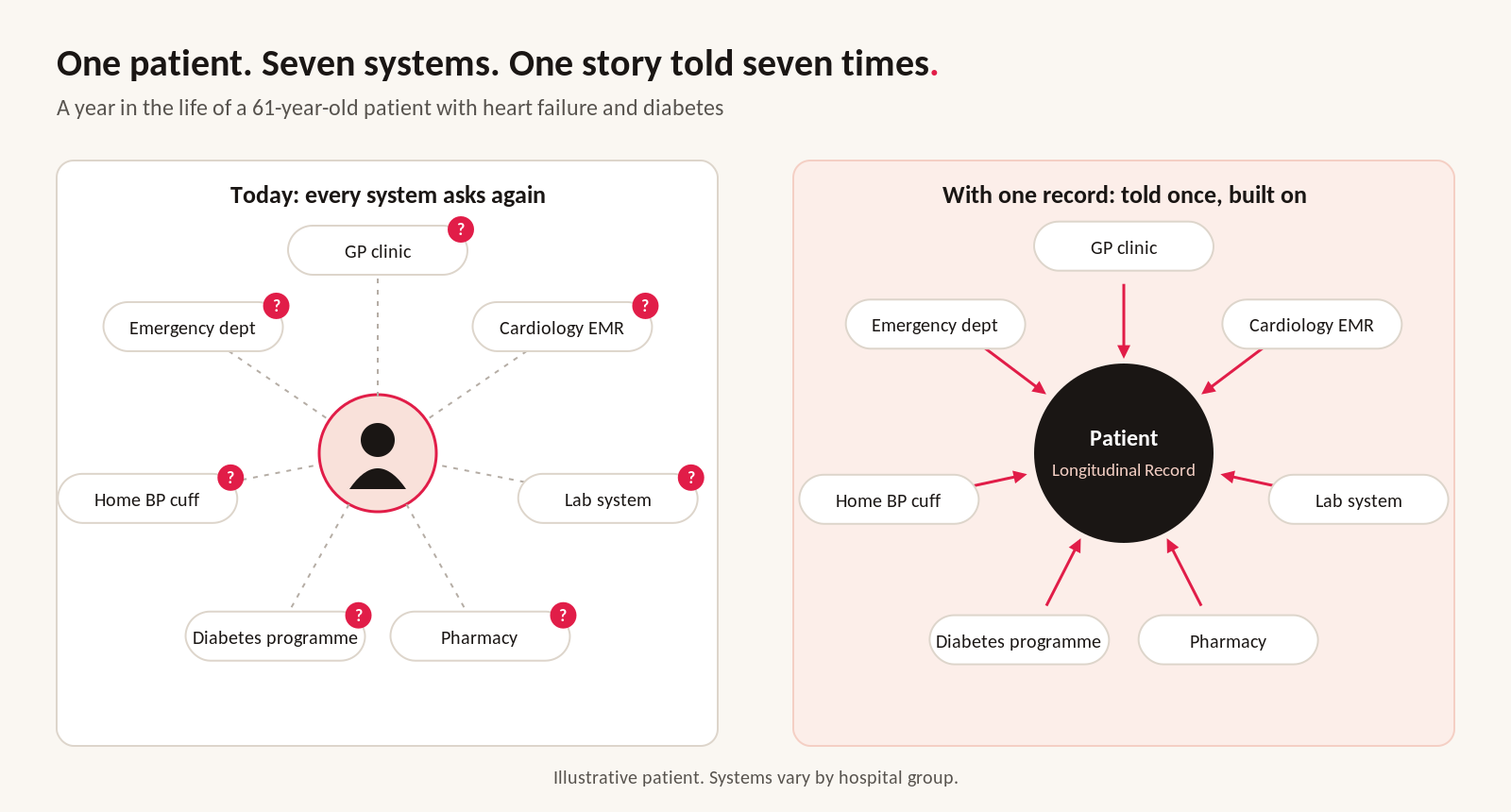
Meet a 61-year-old woman with heart failure and type 2 diabetes. Over twelve months, she sees a GP, a cardiologist, a lab, a pharmacy and a diabetes educator. She also uses a home blood pressure cuff and spends one night in the emergency department.
Each of those places holds a piece of her story. None of them holds all of it. So at every new desk, she tells it again.
She is not unusual. In a survey of 1,014 US adults run for Carta Healthcare, 83% said they had given the same health information more than once. Another 42% said they spent six minutes or more recounting their history at every appointment.
A separate Surescripts study put the cost at about eight minutes per visit on history, plus another eight on forms. That is time patients notice, and time clinicians never get back.
Now replay her year with one record underneath. The cardiologist sees the GP's notes and last month's home readings before she sits down. The diabetes educator knows which tablets changed in cardiology.
The emergency doctor sees her programmes, her medicines, and her daughter listed as carer. She tells her story once, and every system after that builds on it.
This guide explains what a patient longitudinal record is and how it differs from your EMR. It also covers what it asks of your IT team, and how to start in 90 days.
A Patient Longitudinal Record Holds the Relationship, Not Only the Visit
A patient longitudinal record is one connected history for each patient, built across years rather than visits. It draws clinical data from your EMR, hospital management system, and lab, then adds what happens between visits.
You will also see it called a longitudinal health record or a longitudinal EHR. The names vary. The idea is the same: one patient, one record, every year.
The Cura42 website puts the difference plainly. "The EMR holds the encounter. The record holds everything around it: what was taken, what was skipped, what the patient said on a Tuesday in week six."
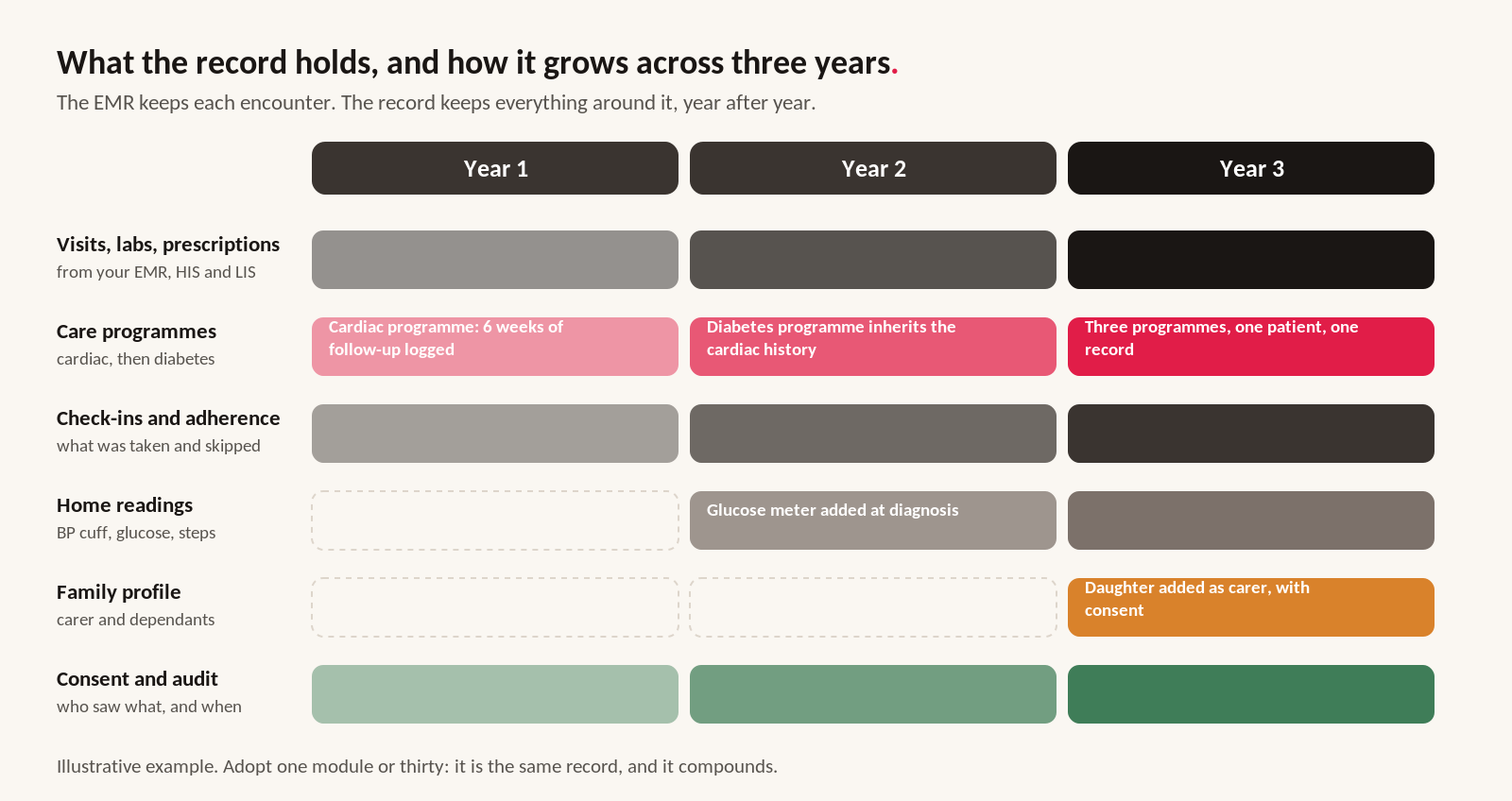
In practice, the Patient Longitudinal Record is designed to hold six kinds of information. These sit alongside the clinical history your EMR already keeps.
- Visit history. Encounters, lab results and prescriptions, read from your EMR, hospital management system and lab.
- Programme history. Every cardiac, diabetes or rehab programme the patient joins, and how far they got.
- Adherence and check-ins. What was taken, what was skipped, and what the patient reported between visits.
- Home readings. Blood pressure, glucose, weight, sleep and activity from devices the patient already uses.
- Family profiles. Carers and dependants, linked with the patient's consent.
- Consent and audit. Who was given access, to what, for how long, and every time someone looked.
The value compounds. A cardiac programme in year one leaves six weeks of logged follow-up. When a diabetes programme starts in year two, it inherits that history instead of starting from a blank page.
The EMR, the National Exchange and the Record: Each Does a Different Job
The most common question from CIOs is simple. Does a longitudinal patient record replace the EMR? No. Your EMR stays the official record, and the longitudinal record works alongside it.
The confusion is understandable, because the terms overlap. An electronic medical record (EMR) holds one organisation's clinical record. An electronic health record (EHR) is often used for records shared more widely.
A longitudinal record does a third job. It keeps the relationship between visits and makes that history usable by the tools you add.
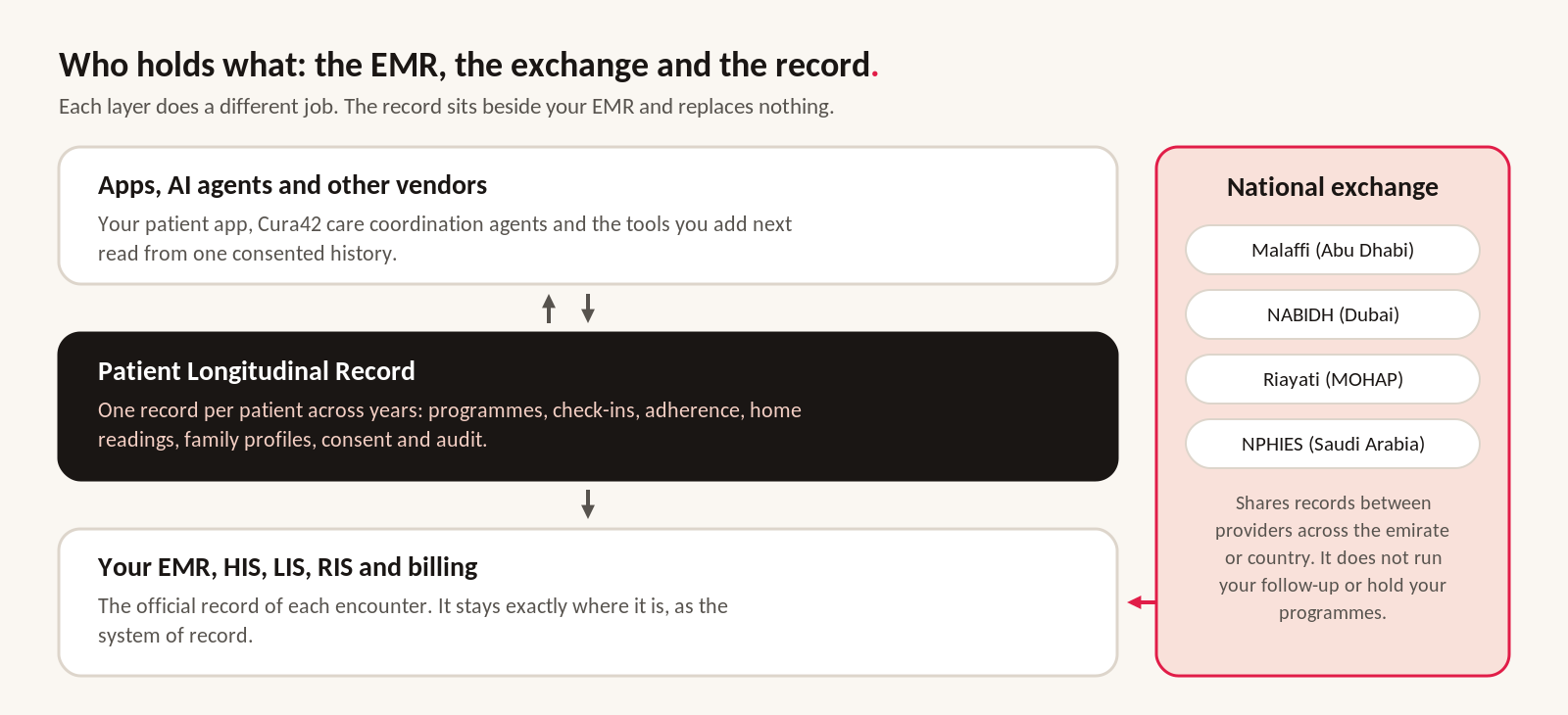
The GCC adds a fourth layer: the national health information exchange. Abu Dhabi's Malaffi is mandatory for licensed facilities and connects every hospital in the emirate. Dubai has NABIDH, the Ministry of Health and Prevention runs Riayati, and the three were linked in 2023.
Saudi Arabia has NPHIES and the Saudi e-Health Exchange. These exchanges matter, and your hospital should stay connected to them. They share records between providers, but they do not run your programmes or your follow-up.
Treat the exchange as a neighbour, not a competitor. Where your licence requires sharing with it, the record should make that easier, never harder.
| Your EMR | National exchange | Patient Longitudinal Record | |
|---|---|---|---|
| Main job | Official record of each encounter | Share records between providers | Keep the relationship between visits |
| Unit of work | The visit | The referral or transfer | The patient, across years |
| Holds home readings and check-ins | Rarely | No | Yes, by design |
| Holds programme history | Partly | No | Yes, by design |
| Who builds on it | The EMR vendor | Licensed providers | Your apps, agents and chosen vendors |
| Replaces anything | No | No | Your apps, agents and chosen vendors |
Six Signs Your Hospital Needs a Longitudinal Record
Not every hospital needs one today. These are the signs that the gap between visits is already costing you.
If three or more apply, the cost is already on your books. It is simply spread across departments, so nobody sees the total.
Fragmented Patient Data Costs Time, Tests and Trust
Fragmented patient data in hospitals rarely shows up as one big failure. It shows up as minutes lost every hour, tests run twice and patients who stop trusting that anyone has the full picture.
Clinicians spend their time searching. In a survey of 92 gynaecologic oncology clinicians, 92% routinely used more than one EHR system. Some 29% used five or more, and 17% said they spent over half their clinical time searching for patient information.
The same data gets typed twice. In a Google Cloud survey of physicians run by The Harris Poll, 62% said they often enter the same data into multiple systems. Another 68% said they spend too much time switching between record systems.
Tests are repeated. In a 2010 pilot of 85 patients transferred between hospitals with incompatible record systems, 32% had a test repeated within 12 hours. A Minnesota study of 8,760 children found more repeat testing when care was spread across more than one health system.
Patients carry the gap. When the history does not follow the patient, the patient becomes the record. They are an unreliable one, through no fault of their own.
These are the everyday healthcare data interoperability challenges your teams already work around. The question is whether you keep paying for them one workaround at a time.
Every New Tool Currently Means Another Integration Project
Here is the pattern most GCC IT teams know well. A new patient app, AI agent, or telehealth service is approved. Then it waits in a queue while IT builds its own connections to the EMR, lab, and billing.
Each project repeats the same mapping, the same security review and the same consent questions. When the next tool arrives, the work starts again.
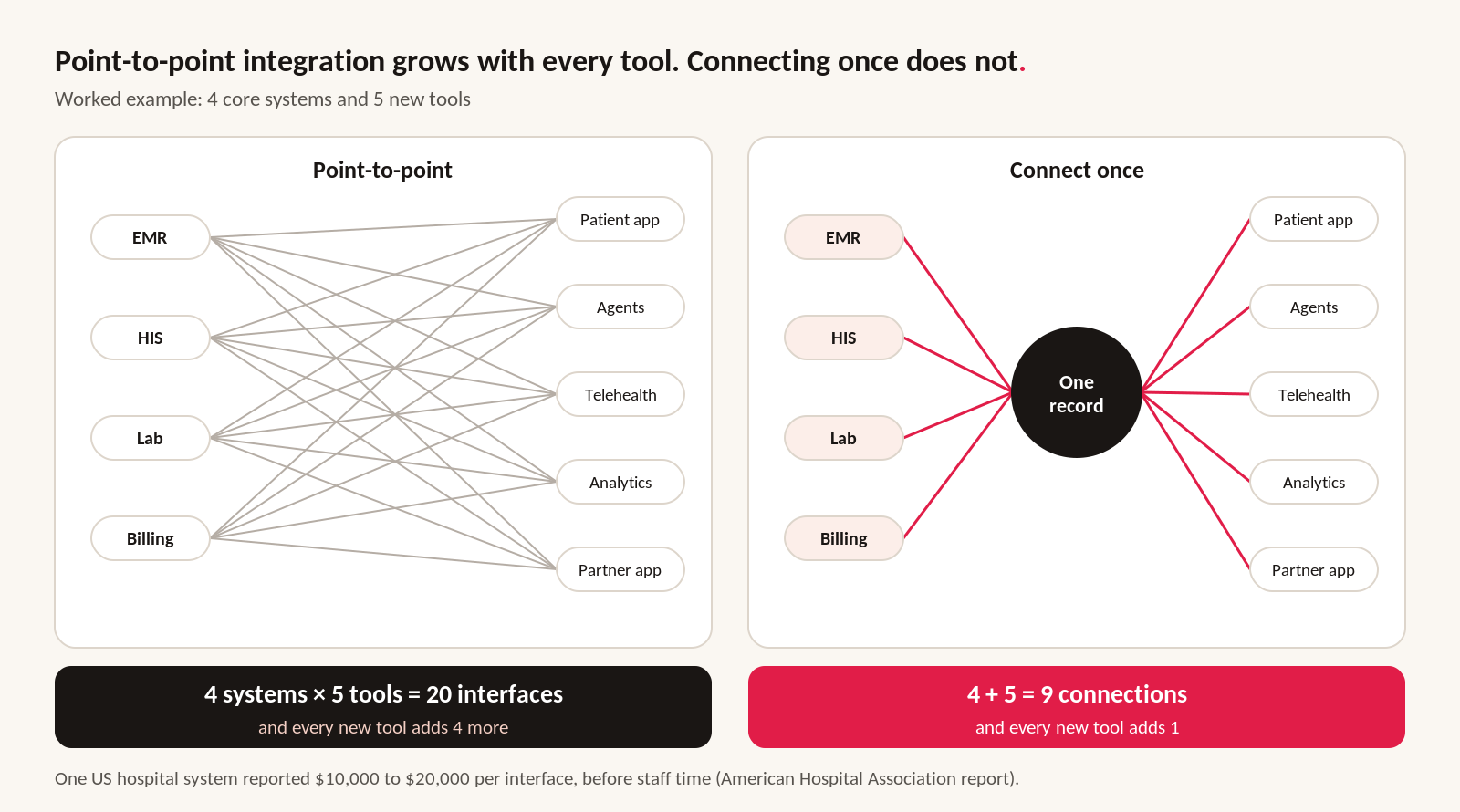
The maths is unforgiving. With four core systems and five new tools, point-to-point integration needs 20 interfaces. A sixth tool adds four more.
Connecting once changes the shape. You integrate your EMR, hospital management system, lab and billing with the record one time. Every new tool then connects to the record, so the same example needs nine connections.
Interfaces are not cheap. An American Hospital Association report cited one US system paying $10,000 to $20,000 per interface. That figure excluded the IT staff time to build and maintain each one.
This is why a healthcare data integration platform pays off over years rather than months. The first connection costs about the same either way. The tenth one is where integrating once and reusing many times shows its value.
The interface fee is only the visible cost. Each project also brings its own security review, its own data protection assessment and its own consent wording for patients.
Then there is the exit cost. When a vendor is replaced, its interfaces are thrown away and its copy of patient history often goes with it. A shared record keeps that history with your hospital, whichever tools come and go.
Use the worksheet below on your own estate. Count honestly, including the tools still waiting in the queue.
| Count this | Your number | Why it matters | |
|---|---|---|---|
| 1 | Core systems holding patient data (EMR, HIS, LIS, RIS, billing) | Each one needs a connection in every point-to-point project | |
| 2 | Patient-facing tools live today | Each one already carries its own interfaces to maintain | |
| 3 | Tools approved but waiting on integration | Your backlog, and the cost of standing still | |
| 4 | Interfaces needed point-to-point (systems × tools) | The total your IT team is on the hook for | |
| 5 | Connections needed via one record (systems + tools) | The total if each system and tool connects once |
HL7 and FHIR Make Connection Possible, Not Automatic
FHIR and HL7 interoperability standards are why connecting once is now realistic. HL7 version 2 has carried lab results and admissions messages for decades. FHIR is the newer standard, built around web APIs that modern apps can call.
The HL7 vs FHIR question is rarely either-or. Most hospital estates run both, with HL7 v2 feeds from older systems and FHIR APIs on newer ones.
Adoption is rising. HL7 International and Firely run an annual State of FHIR survey. In 2025, 71% of respondents said FHIR is used for at least a few use cases in their country, up from 66% in 2024.
Supporting a standard is not the same as being connected, though. Two systems can both "support FHIR" and still need weeks of mapping, testing and security sign-off.
Most of that work is about meaning, not plumbing. A lab result coded one way in your lab system may be coded differently in your EMR.
Shared terminologies help. LOINC codes lab tests, SNOMED CT codes clinical findings, and ICD-10 codes diagnoses. A record that maps to them once spares every later tool the same translation work.
So ask three practical questions about FHIR APIs for hospitals before you commit. Which of our systems expose an API today? Which only send HL7 v2 messages? Which have no interface at all?
Cura42 connects over HL7 and FHIR, and today offers a REST API and SDK for the record. Where a system has no API, the Cura42 team scopes the connection with your IT team before work starts.
Consent Belongs in the Record, Not Inside Every App
Patient consent management in healthcare is usually rebuilt, tool by tool. Each new app asks for its own permissions, stores them its own way and answers its own audit questions.
That approach breaks as soon as a patient changes their mind. Withdrawal has to reach every copy, and nobody can say with confidence who saw what.
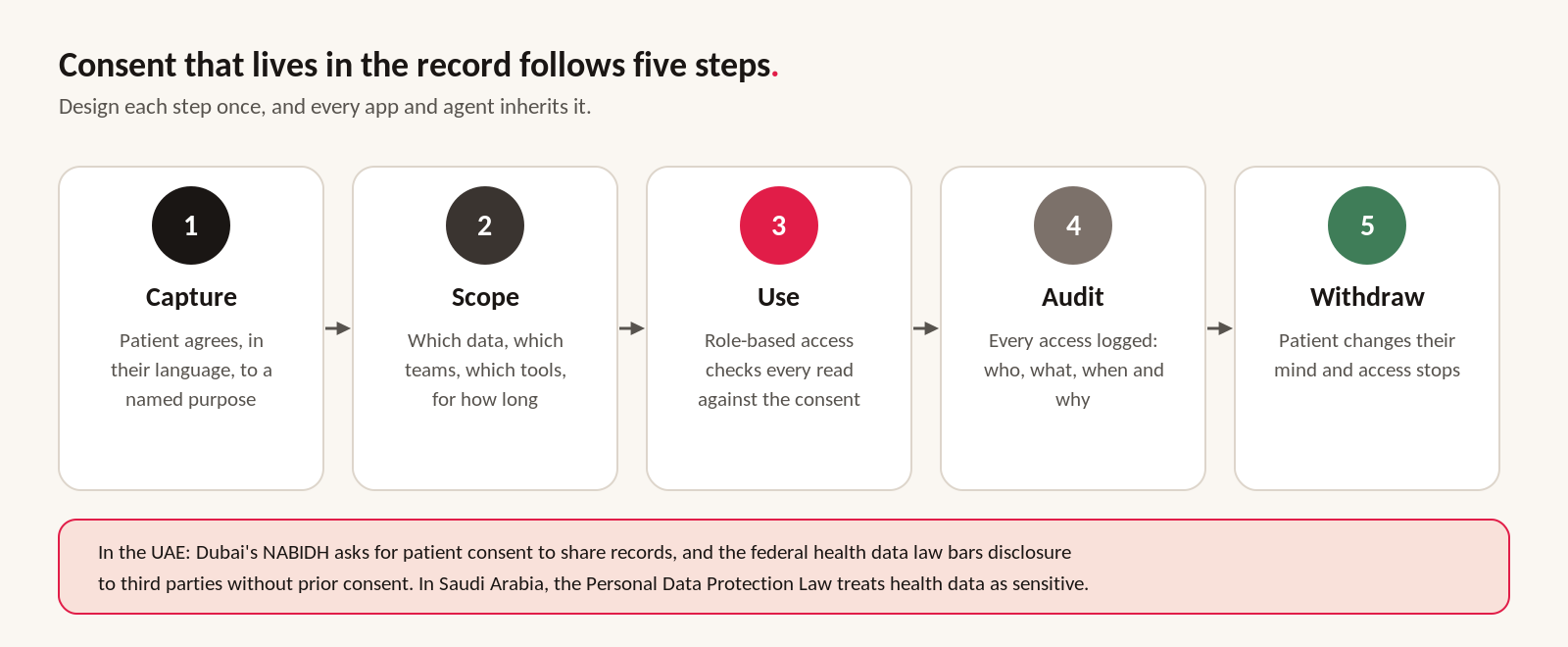
The rules in the region raise the stakes. Dubai's NABIDH requires facilities to obtain patient consent before sharing records, and patients can opt out. The UAE federal health data law bars disclosure to third parties without prior consent.
The same UAE law requires health data to be kept for at least 25 years after the last procedure. Article 13 also stops it from being stored or processed outside the country unless an exception applies.
In Saudi Arabia, the Personal Data Protection Law treats health data as sensitive and sets stricter conditions for processing. Your record has to answer to all of these, every day.
Consent-aware data exchange means the consent travels with the data. Role-based access control means a physiotherapist sees rehab notes, not psychiatric history. Audit logs mean your hospital can show who opened a record, when, and why.
The Patient Longitudinal Record is designed to keep consent, role-based access, and audit logs in the record itself. Every app and agent built on it then inherits the same rules, instead of reinventing them.
Home Readings Only Help When They Land Beside the Clinical Record
Patient-generated health data is growing fast. Patients arrive with blood pressure logs, glucose readings, step counts and sleep scores. Most hospitals have nowhere useful to put them.
Doctors want the data, but the plumbing is missing. In a 2026 American Medical Association survey of 2,222 physicians in six countries, most reviewed wearable data at least sometimes. Yet only 6% of US physicians said it was built into their clinical workflow.
The barriers were practical: workflow fit, payment and trust in data quality. A reading on a patient's phone is invisible to the next doctor. A reading in the record can be searched, trended and flagged.
Three rules make wearable data in the patient record useful rather than noisy. First, store it beside the clinical history, with the device and date attached. Second, let clinicians set the limits that turn a reading into a flag.
Third, route those flags into a pathway with a named owner. Remote monitoring data integration without an owner just creates an inbox nobody reads.
This is where the record and Cura42 care coordination agents meet. The agent asks for the reading on the protocol's schedule, the record stores it, and anything outside your limits reaches a nurse.
AI Agents Are Only as Good as the History They Read
Every board in the region is asking about AI. Very few hospitals have asked what their AI will read.
An AI agent that checks on a cardiac patient needs to know their medicines, their last readings and what they said last week. Without that, it asks the patient again, which is exactly the problem you were trying to solve.
A data foundation for healthcare AI agents has three properties. The history is connected across systems. Consent is already settled. Every read is logged, so a clinician can see why the agent said what it said.
That is the practical meaning of AI-ready patient data. It is less about models and more about whether the record underneath is complete, current and consented.
Explainability depends on it as well. When a clinician asks why an agent flagged a patient, the answer is one click away: the reading, the threshold and the protocol behind it.
It also changes how you buy. When the record is in place, a new agent or vendor starts from a connected history. Without it, each one starts with another integration and another compliance review.
Patients Should See and Manage Their Own Record
A record built around the patient should be open to the patient. The Patient Longitudinal Record is designed to let patients view their history and manage who can see it.
That matters for trust. A patient who can see what was shared, and with whom, is more willing to share it in the first place.
It matters commercially too. When a patient's full history lives with your group, they have one more reason to come back to you rather than start again somewhere new.
Keep the patient view simple. Show the timeline, the programmes they are in, their recent readings, and a clear list of who has access, with a way to change it.
Each Team Gets Something Different from One Record
A longitudinal record is bought by IT, but most of its value lands elsewhere. Knowing who gains what helps you build the business case and win support early.
The contact centre. Whoever picks up the phone sees the patient's history, so routine questions get answered on the first call. Fewer patients call back about the same thing.
Nursing. What the patient was told at discharge, and what they reported since, is written down in one place. The nurse calling about a high reading starts with context.
The CMO. Every contact is documented against the protocol your clinicians approved. That gives you an audit-ready answer when a regulator or an accreditation surveyor asks.
The patient. One route back to the hospital, with their history already known. They stop being the record and go back to being the patient.
Start with an Inventory, Not a Platform Decision
You do not need a two-year programme to begin. You need a clear picture of where patient data sits today, and one service that would benefit from a shared history.
AI Agents Are Only as Good as the History They Read
Every board in the region is asking about AI. Very few hospitals have asked what their AI will read.
An AI agent that checks on a cardiac patient needs to know their medicines, their last readings and what they said last week. Without that, it asks the patient again, which is exactly the problem you were trying to solve.
A data foundation for healthcare AI agents has three properties. The history is connected across systems. Consent is already settled. Every read is logged, so a clinician can see why the agent said what it said.
That is the practical meaning of AI-ready patient data. It is less about models and more about whether the record underneath is complete, current and consented.
Explainability depends on it as well. When a clinician asks why an agent flagged a patient, the answer is one click away: the reading, the threshold and the protocol behind it.
It also changes how you buy. When the record is in place, a new agent or vendor starts from a connected history. Without it, each one starts with another integration and another compliance review.
Patients Should See and Manage Their Own Record
A record built around the patient should be open to the patient. The Patient Longitudinal Record is designed to let patients view their history and manage who can see it.
That matters for trust. A patient who can see what was shared, and with whom, is more willing to share it in the first place.
It matters commercially too. When a patient's full history lives with your group, they have one more reason to come back to you rather than start again somewhere new.
Keep the patient view simple. Show the timeline, the programmes they are in, their recent readings, and a clear list of who has access, with a way to change it.
Each Team Gets Something Different from One Record
A longitudinal record is bought by IT, but most of its value lands elsewhere. Knowing who gains what helps you build the business case and win support early.
The contact centre. Whoever picks up the phone sees the patient's history, so routine questions get answered on the first call. Fewer patients call back about the same thing.
Nursing. What the patient was told at discharge, and what they reported since, is written down in one place. The nurse calling about a high reading starts with context.
The CMO. Every contact is documented against the protocol your clinicians approved. That gives you an audit-ready answer when a regulator or an accreditation surveyor asks.
The patient. One route back to the hospital, with their history already known. They stop being the record and go back to being the patient.
Start with an Inventory, Not a Platform Decision
You do not need a two-year programme to begin. You need a clear picture of where patient data sits today, and one service that would benefit from a shared history.
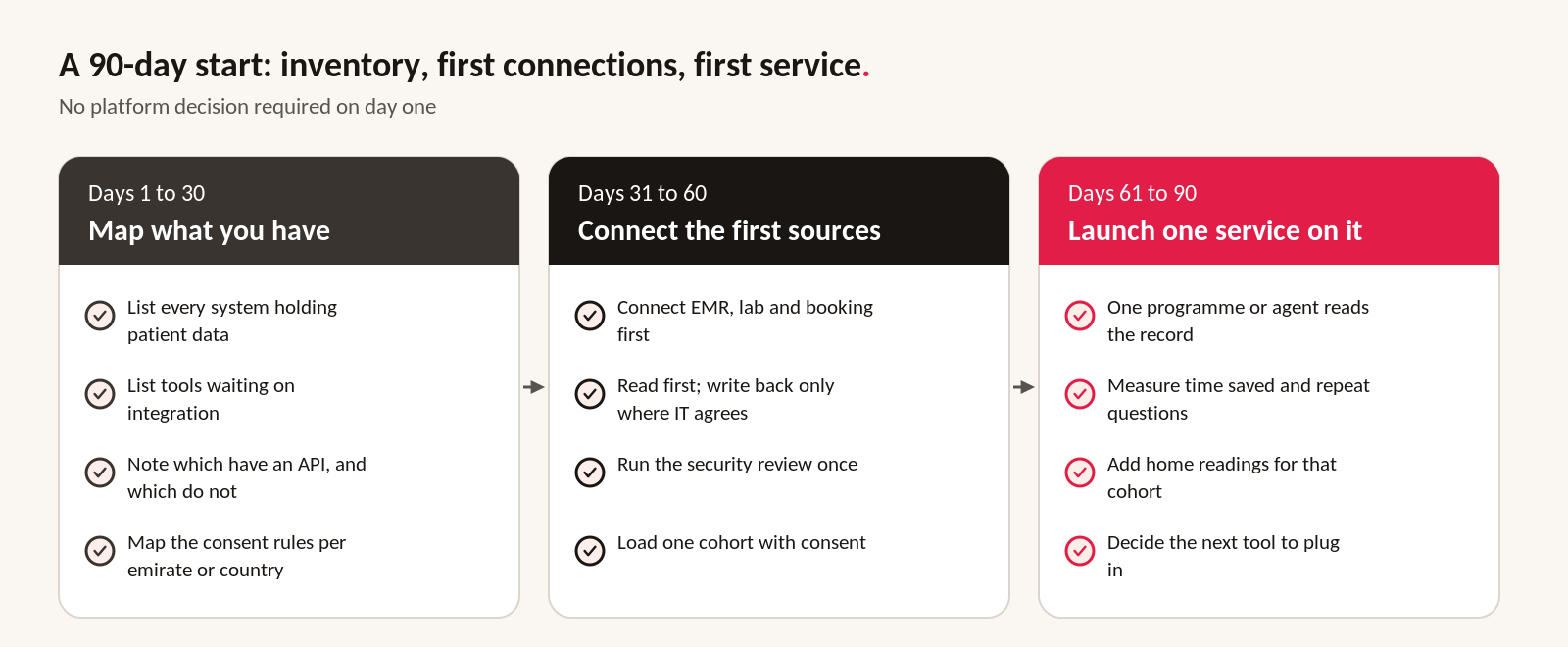
Days 1 to 30: map what you have. List every system holding patient data and every tool waiting on integration. Note which systems expose an API, which send HL7 v2 messages, and which have no interface.
Days 31 to 60: connect the first sources. Start with the EMR, lab, and booking system. Read first, write back only where IT agrees, and run the security review once.
Days 61 to 90: launch one service on it. Point one programme or agent at the record for one cohort. Measure repeat questions avoided and time saved, then choose the next tool to connect.
Decide your day-90 measures before day one. Good ones are simple: integration time for the next tool, repeat history questions per visit, and patients with consent recorded.
Add one clinical measure for the first service, such as follow-ups completed. That keeps the record tied to outcomes, not only to architecture.
A patient data integration audit at the start makes this faster. It shows which systems matter most for your first service and where consent rules differ by emirate or country.
Agree who owns what before day one. The CIO owns the connections and the security review. A clinical lead owns which data the first service needs, and the data protection officer owns the consent model.
Ten Questions to Ask Any Longitudinal Patient Record Platform
Send these to every vendor in writing. Compare the replies side by side, and treat vague answers as answers.
- Does it replace our EMR, or sit beside it? The right answer keeps the EMR as the system of record.
- Which of our systems can you connect today, and how? Ask for HL7 v2, FHIR, REST API or custom, system by system.
- What happens when a system has no API? Look for a scoped plan your IT team approves first.
- What do you read, and where do you write back? Read-first, with write-back only where IT agrees, keeps risk low.
- Where is patient data stored and processed? In the UAE, ask how the set-up meets Article 13.
- How is consent captured, scoped, and withdrawn? Ask to see withdrawal stop access across every tool.
- Who can see what, and how is that enforced? Expect role-based access checked on every read.
- What does the audit log record? It should show who, what, when, and why for every access.
- Can other vendors and our own teams build on it? Ask how, and what they need to connect.
- What is outside the product? A clear answer on scope builds more trust than a long feature list.
What a Patient Longitudinal Record Is Not
Being clear on scope saves months of misunderstanding. The Patient Longitudinal Record is not an EMR replacement, so nothing you run today is ripped out.
It is not a data warehouse or a business intelligence platform. It is not population health analytics or general data lake consulting either.
It is the connected patient history your own services build on. That narrow job is the point.
Be wary of any vendor promising all of those in one product. Ask which hospital runs every one of them today. Breadth on a slide is easy, and depth in production is not.