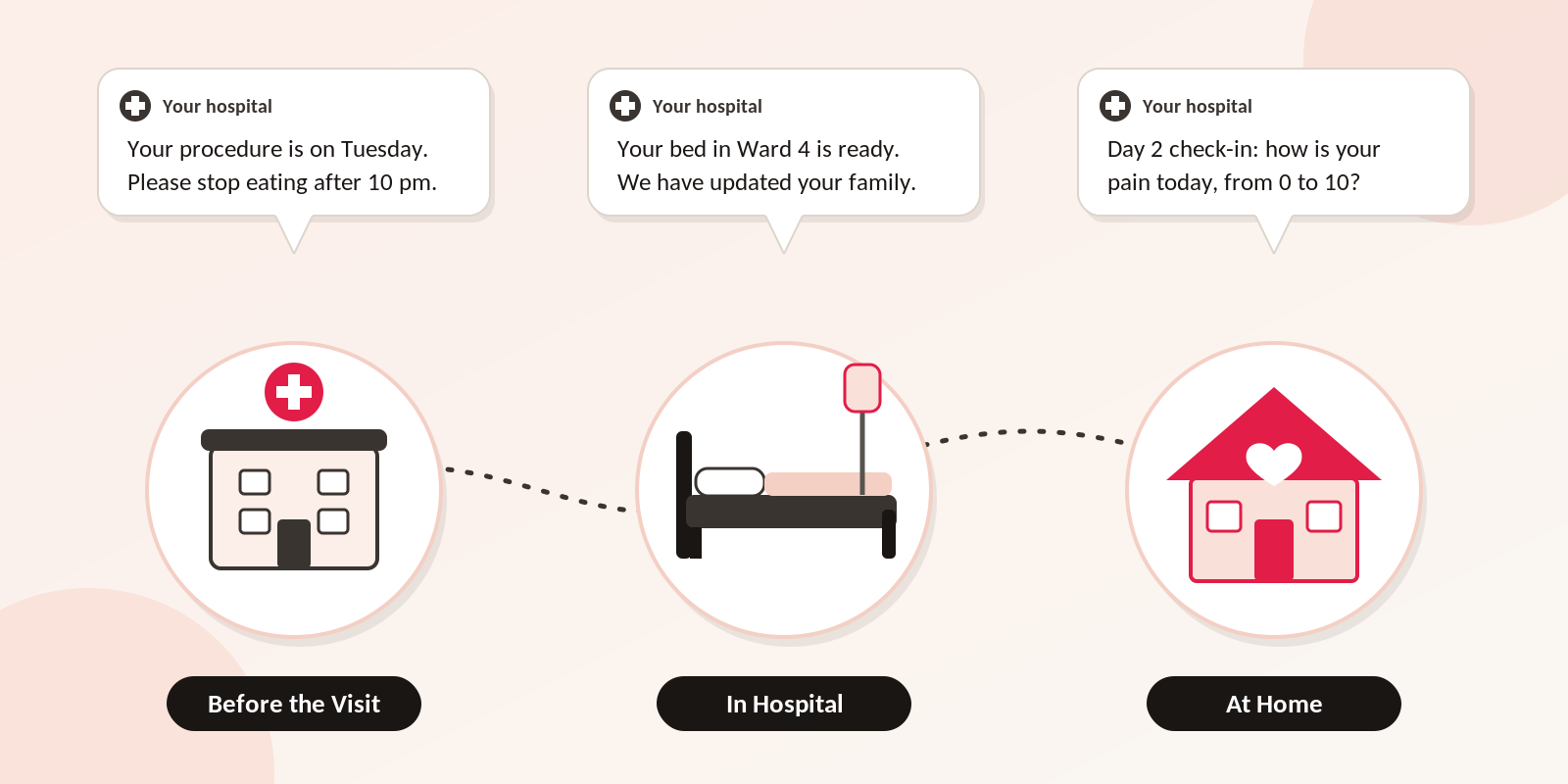
Your hospital is very good at caring for the patient in the bed. The harder job starts when that patient goes home.
Take a knee replacement patient. They leave with a printed sheet and a review date. By day three, they cannot remember which tablet changed.
By day ten, the contact centre has moved on to this week's discharges. By day 42, the six-week review has not been booked, and the physiotherapy is happening at a clinic near their office. Day 0 had every system in the hospital watching.
Days 1 to 41 were nobody's job. The roster simply ran out before the protocol did.
Care coordination AI agents are built for that gap. They keep your protocol running for every patient, for as long as it says, and they pass anything that needs judgement to your staff.
This guide answers what are care coordination AI agents and what they do at each stage. It also shows how your clinicians stay in charge and how to pick the first one.
Each Agent Has One Job: Finish a Step of Your Protocol
Most talk about AI agents in healthcare is about diagnosis and clinical notes. Care coordination agents do plainer, more valuable work.
A care coordination AI agent is an AI agent that owns one step of your hospital's patient protocol. It keeps at it until the step is done or a person takes over. The step might be a day-two recovery check-in, a fasting reminder before surgery or a booked six-week review.
That single goal is the difference. A CRM reminder sends a message and forgets the patient. An agent sends the message, reads the reply, follows up when the patient goes quiet, and records whether the review was booked.
It also answers only from material your clinicians have approved, such as discharge instructions, procedure guides and agreed replies. A question outside that material goes straight to a named member of staff. The agent does not guess.
One note on the name. Search "care coordinator" in Dubai or Riyadh and most results are job adverts for the human role.
The agent does not replace that person. It takes the routine calls off their list, so they spend the day on patients who need a human.
Care coordination vs care management. Care management is the clinical plan for a patient with a long-term condition. Care coordination is making sure every step of that plan actually happens. Agents work on the second.
| Chatbot on your website | CRM or WhatsApp reminder | Human care coordinator | Care coordination AI agent | |
|---|---|---|---|---|
| Who starts the conversation | The patient | The hospital, once | Either | The hospital, on the protocol's days |
| Checks the step happened | No | No | Yes, when time allows | Yes, for every patient |
| Answers from | General content | Nothing, it only sends | Training and experience | Your approved clinical material only |
| Hands over to a person | Sometimes | No | Already a person | Always, by rules your clinicians set |
| How long it keeps going | Until the patient leaves the page | One send | Until the roaster runs | As long as the protocol runs |
| What gets reported | Chats | Message sent | Calls made | Patients reached and steps completed |
Your Roster Runs Out Before Your Protocol Does
Care coordination in hospitals across the GCC comes down to the same sum. Each patient now needs more touchpoints than your team has hours to give.
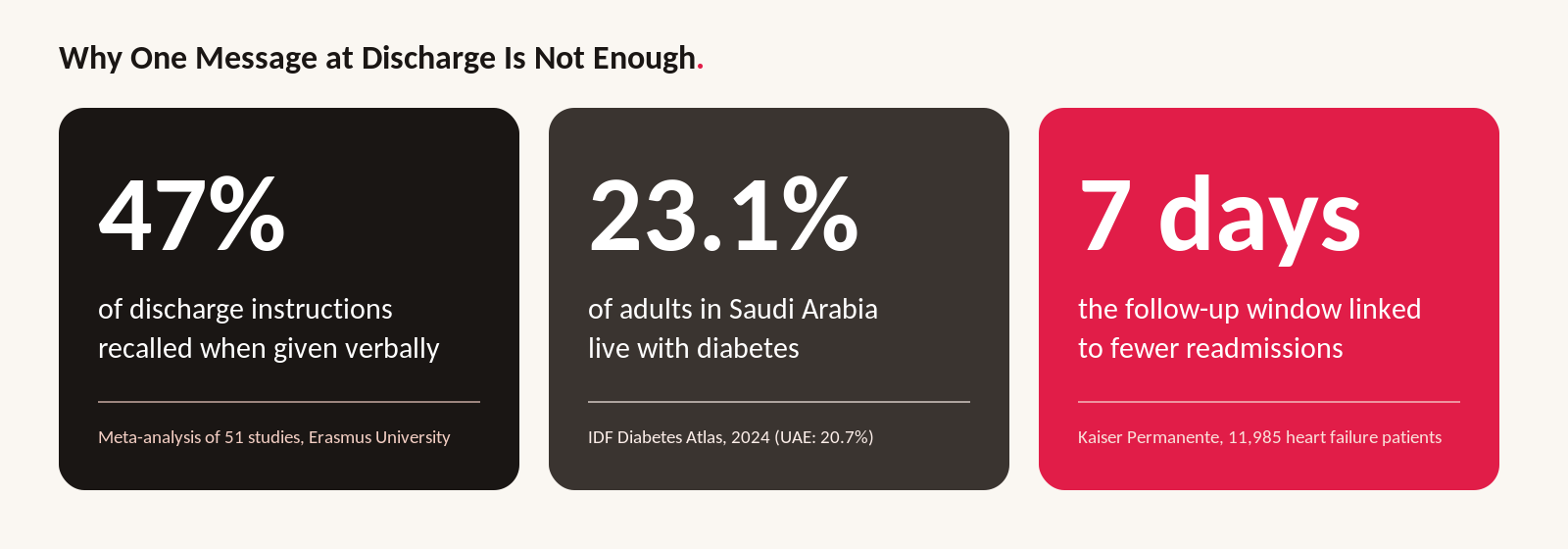
Patients forget most of what they hear at discharge. A review of 51 studies found patients correctly recalled about 47% of emergency discharge instructions given verbally (meta-analysis, Erasmus University). In a separate inpatient study, only 43% recalled their medication changes (AONL summary of a Joint Commission study). One conversation at the bedside will not hold.
Long-term patients need you for years. The IDF Diabetes Atlas puts diabetes at 23.1% of adults in Saudi Arabia and 20.7% in the UAE, age-standardised. Each of those patients needs reviews, lab tests and check-ins on a schedule that never ends.
The team is not growing at the same rate. A 2023 estimate found Saudi Arabia needs 175,000 more healthcare workers by 2030 (Al Arabiya). The contact centre feels it first. Each discharge adds a name to the list, so the oldest names quietly drop off the bottom.
The window is short. Kaiser Permanente studied 11,985 heart failure patients. Contact within seven days of discharge was linked to lower odds of readmission within 30 days. Contact after day seven showed no clear effect (Kaiser Permanente Division of Research).
Add those together and you get patient leakage that nobody sees on a dashboard. In a survey of 104 US health system leaders, 43% estimated they lose more than 10% of revenue to patients who go elsewhere. Another 23% could not say (Healthcare Finance News).
GCC groups rarely publish the figure. That is the problem. A loss nobody counts is a loss nobody fixes.
Agents Cover the Visit, the Stay, the Recovery and the Years After
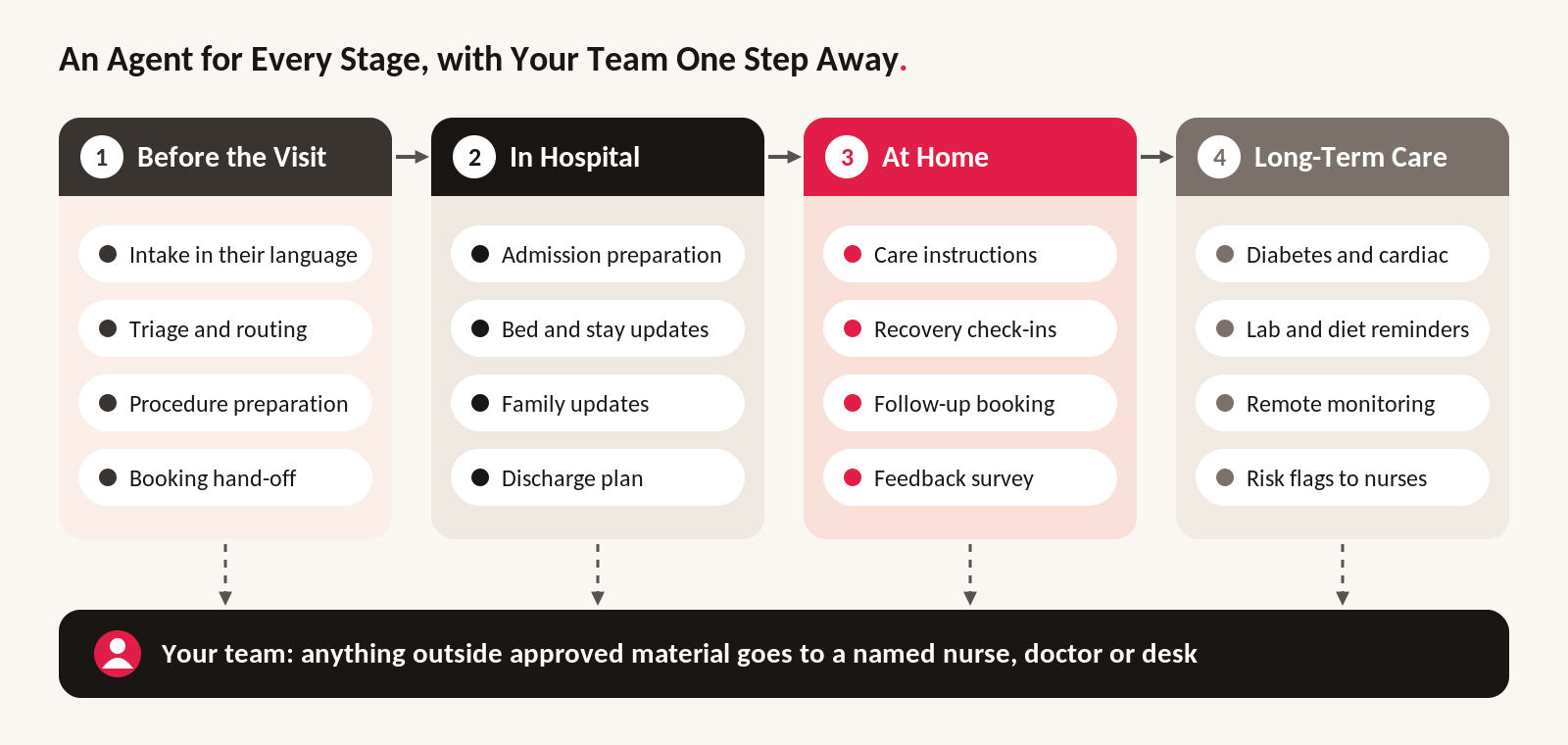
Agents follow the whole patient care journey, from the first enquiry to a decade of diabetes reviews. Each stage has its own agents, and each agent has one goal.
Before the Visit
The goal is a patient who turns up on the right day, at the right department, ready. An intake agent takes the patient's details on WhatsApp, the hospital app or the web, in their own language.
A triage agent asks about symptoms, judges urgency against your rules and routes the patient. A hand-off agent passes them to booking, or to a person when one is needed.
Pre-procedure patient preparation is where many cancellations start. A preparation agent sends fasting, medication-hold and travel instructions on the days your protocol sets, then confirms each one.
A patient still taking a blood thinner gets flagged to your team before the theatre slot. Not in pre-op.
In Hospital
The goal is beds and theatre slots used as planned, and a family that is not ringing the ward every hour. An admission agent guides the patient from outpatient to admission.
A status agent tells the patient and family when the bed is ready and how the stay is going. A discharge agent books the first follow-up before the patient leaves the building.
At Home
This is where most hospitals lose the patient, so post-discharge follow-up is where most start. An instructions agent sends post-procedure guidance and medication reminders. A recovery agent checks in on the days your protocol names and brings in a nurse when an answer crosses your limits.
A booking agent offers the follow-up during the check-in. A feedback agent asks how the visit went.
Long-Term Care
The goal is a patient still on the programme in year three. Programme agents run chronic care management for diabetes, cardiac, orthopaedic and respiratory pathways.
They track physiotherapy against a plan, remind patients about lab tests and take in readings from home devices. A risk agent flags any reading outside your clinicians' limits and sends it to a nurse.
Every review, test and procedure these patients need for the next ten years stays with the group that kept in touch.
Your Clinicians Decide Every Word the Agent Says
Before an agent contacts a single patient, your clinical team sets four things. The agent cannot step outside them.
- The job. The step it has to finish, such as a completed day-two check-in or a booked review. A clear job is what makes the agent measurable.
- The source. Your discharge instructions, procedure guides and approved replies. Nothing else.
- The voice. Your hospital's name, tone and languages. Patients hear from you, never from a software vendor.
- The hand-over. Which answers go straight to a person, which person, and how fast. A patient who reports chest pain or a fever above your limit is never left with the agent.
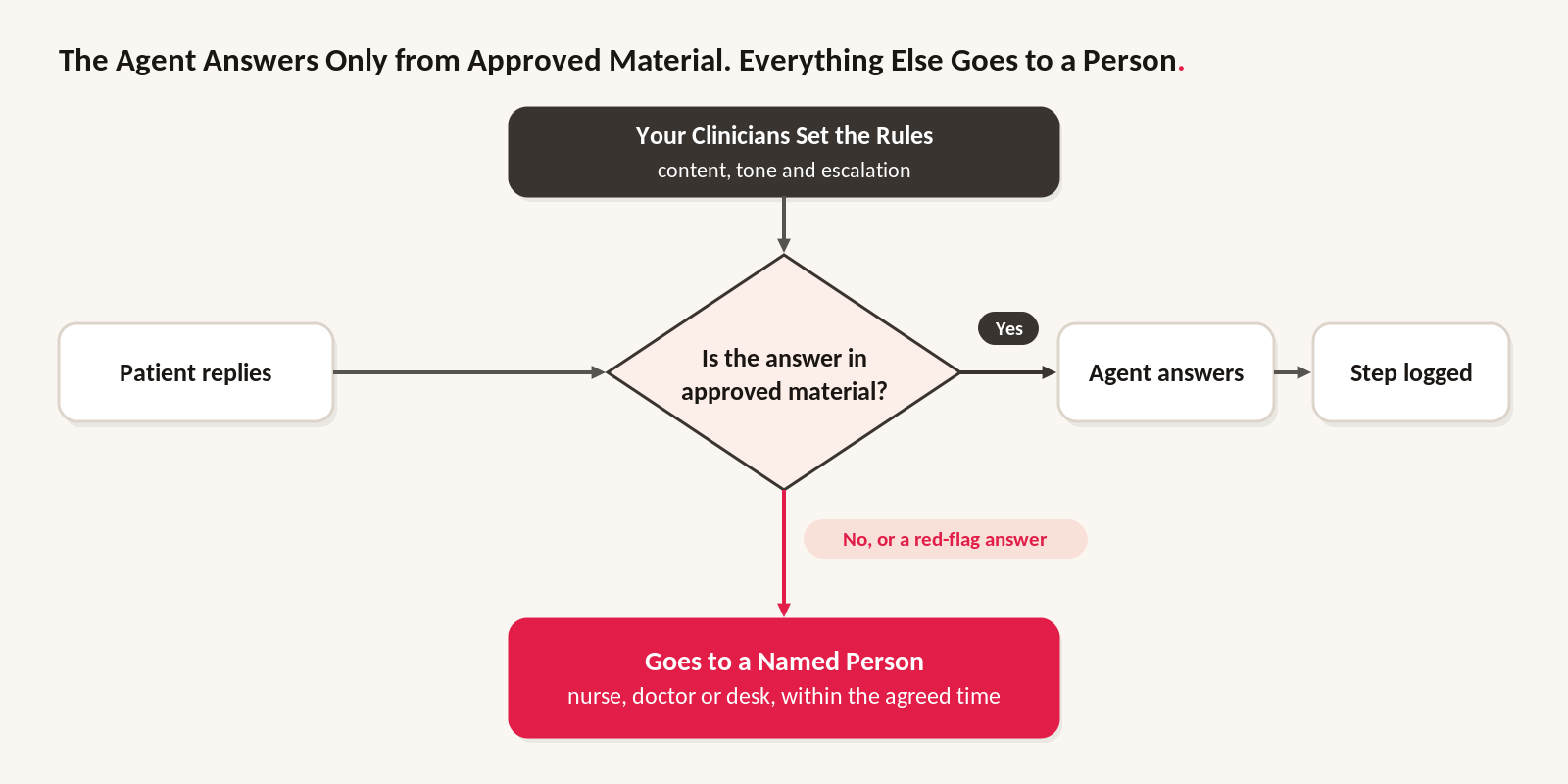
This is how to answer the CMO who asks what happens when the agent gets it wrong. It has nothing to improvise. It either replies with words your clinicians already signed, or it hands over.
Protocols change, and the agent has to change with them. A surgeon updates a recovery instruction. A new cardiac programme starts.
Agree up front who owns those updates and how fast they go live. With Cura42, the implementation team updates the agent whenever your clinicians change a rule. Your IT team never inherits a support queue it was not staffed for.
Safety, Data Residency and GCC Rules Come Before Features
Hospital leaders are right to start here. In a 2026 Wolters Kluwer survey, providers and administrators ranked patient safety as their top worry about AI agents in healthcare and other AI tools. Providers put inaccurate answers second (Wolters Kluwer).
The same survey found 40% had already seen unapproved AI tools inside their own organisation. Your staff are using AI either way. The real choice is whether it runs under your rules.
Get a straight answer on four points before any pilot.
Clinical safety. Ask how the vendor tests answers before go-live and how they report accuracy after it. A named test method and a number. Not "it is very accurate".
Patient trust. Patients want a person when it matters. A 2026 survey of patients in the US, UK and Canada found 90% prefer a real person to AI (WellReceived, via Santelog).
GCC data is not published, but the lesson travels. Tell patients at discharge that the hospital will check in, send every message in the hospital's name, and keep a person one reply away.
AI regulation. The Department of Health Abu Dhabi's AI policy asks for certification from recognised bodies, auditable validation and "graceful degradation". That means automatic alerts and a safe shutdown if the system fails (Al Tamimi summary). Ask every vendor what happens to live patient conversations when their system goes down.
Where the data lives. Article 13 of UAE Federal Law No. 2 of 2019 covers health data on care delivered in the UAE. It cannot be stored or processed abroad unless a listed exception applies (CMS). In Dubai, sharing records through NABIDH needs the patient's consent (DHA NABIDH consent policy).
Saudi Arabia's Personal Data Protection Law treats health data as sensitive. Agents should read from your electronic medical record (EMR) first and write back only where your IT team agrees.
Cura42 is designed to hold patient data only with the patient's consent and under your access rules, and your IT team reviews security before go-live. Each patient's history sits in one Patient Longitudinal Record, so every agent works from the same consented record.
This section is general information, not legal advice. Confirm current requirements with your regulator and legal team.
Start with the Journey Where You Lose the Most Patients
The best first agent is rarely the one with the best demo. Pick the step that leaks the most patients, prove it there, and the next business case writes itself. Four steps get you there.
Step 1. List your journeys. Write down the five to eight journeys that carry most of your volume, such as elective orthopaedics, maternity, cardiac and day-case procedures. Mark every point where the patient has to act without staff in the room.
Step 2. Count the drop-off. For each journey, pull three numbers from the last 90 days: patients due a follow-up, patients reached and patients who booked the next step. Most hospitals have the first.
Few have the third. A number you cannot find is a finding.
Step 3. Score each gap. Rate each journey from 1 to 5 on monthly volume, the value of the next visit and the clinical risk if the step is missed. Add a fourth score for protocol readiness.
A written, signed-off protocol scores 5. An informal habit scores 1.
Step 4. Run one agent for 90 days. Pick the highest total, agree the success measure before go-live and track it against your baseline. Measure patients reached and steps completed.
| Patients per month | Value of next step | Clinical risk if missed | Protocol ready | Total | |
|---|---|---|---|---|---|
| Post-discharge, elective orthopaedics | 4 | 5 | 4 | 5 | 18 |
| Diabetes programme reviews | 5 | 4 | 4 | 3 | 16 |
| Pre-procedure preparation, day cases | 4 | 3 | 4 | 4 | 15 |
| Maternity follow-up | 3 | 3 | 4 | 3 | 13 |
Example scoring worksheet (1 = low, 5 = high). Scores are illustrative, for a sample hospital.
Post-discharge follow-up wins this exercise more often than not. The volume is high, the next visit is valuable, and the seven-day window is easy to miss. Our next guide walks through post-discharge follow-up step by step.
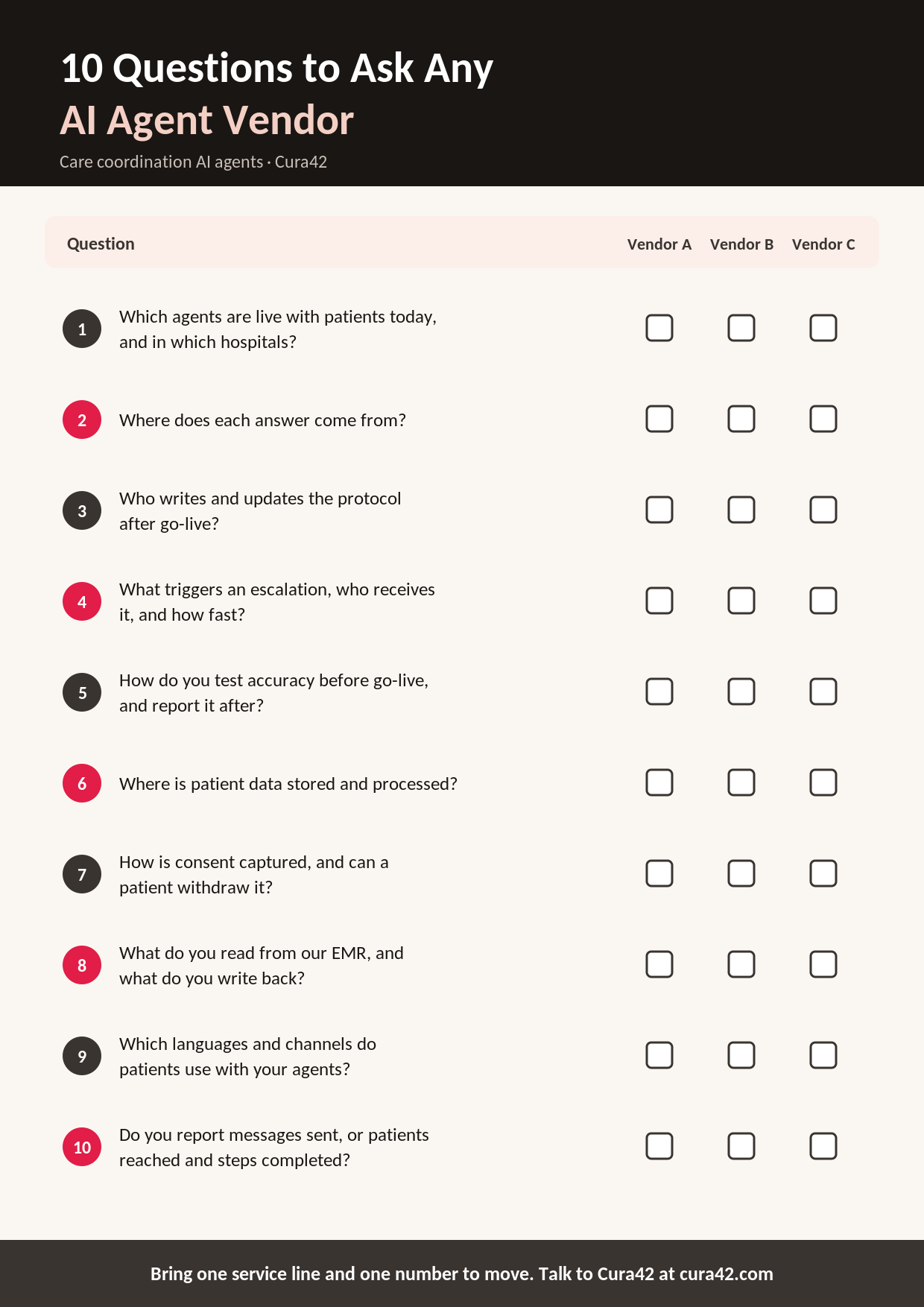
Ten Questions Separate a Real Agent from a Reminder Tool
Before you shortlist an AI care coordination platform, send every vendor the same ten questions in writing and compare the replies side by side. Vague answers tell you as much as good ones.
- Which agents are live with patients today, and in which hospitals? Ask for the live list, kept apart from the roadmap.
- Where does each answer come from? The right reply is "your approved material only", with everything else handed to a person.
- Who updates the protocol after go-live? If the answer is your IT team, ask who pays for that time.
- What triggers a hand-over, who receives it, and how fast? Ask to see the rules for one real pathway.
- How do you test accuracy before go-live, and report it after? Expect a named method and a number.
- Where is patient data stored and processed? In the UAE, ask how the set-up meets Article 13. In Saudi Arabia, ask about the Personal Data Protection Law.
- How is consent captured, and can a patient withdraw it? Ask where the consent record lives.
- What do you read from our EMR, and what do you write back? Read-first, with write-back only where your IT team agrees, keeps the EMR as the official record.
- Which languages and channels do your agents use? Arabic and English at minimum, plus the languages of your largest patient groups, on channels they already use.
- What do you report? Messages sent tells you nothing. Patients reached and steps completed tells you whether follow-up happened.