
Two Discharges, One Patient and Two Different Endings
A 58-year-old man goes home from your cardiac ward on a Sunday afternoon. He has a printed discharge summary, three changed medicines and a review due in six weeks. His recovery depends almost entirely on what happens over the next 42 days, and almost none of it happens inside your hospital.
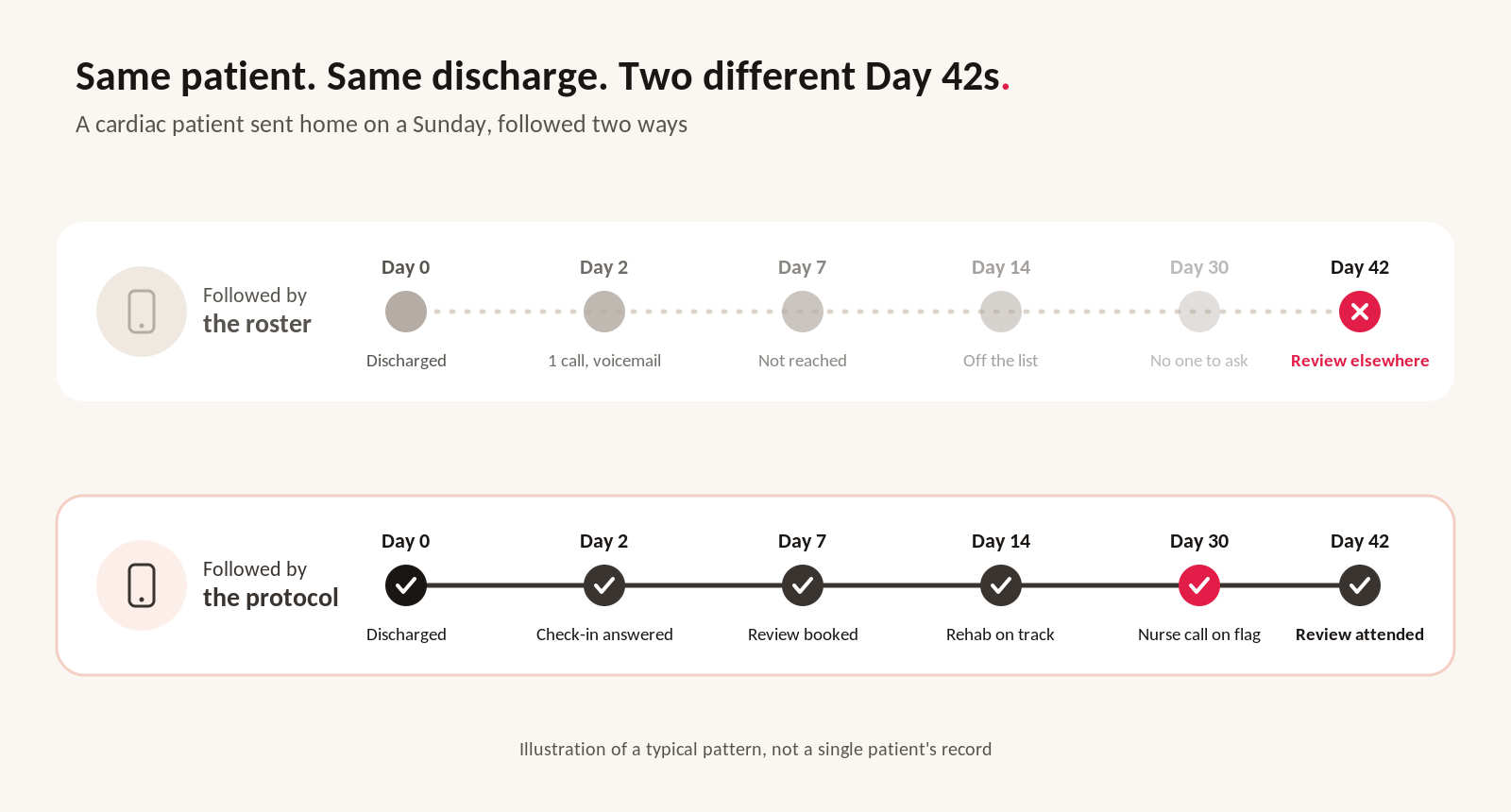
Follow him through the roster first. On day two, the contact centre calls once and reaches voicemail. By day seven, a fresh batch of discharges sits above him on the list.
By day fourteen, he has fallen off it. On day thirty, his ankles swell and he has nobody to ask, so he waits. On day forty-two, he books his review at a clinic near his office, because that clinic sent him a message and yours did not.
Now follow the same man through the protocol. On day two, an agent checks in on WhatsApp in Arabic and asks about his breathing and his new tablets. On day seven, it offers the review slot inside the chat and he books it.
On day thirty, he mentions the swelling, the agent flags it amber, and a nurse calls him the next morning. On day forty-two, he walks into your outpatient clinic.
Same patient, same discharge, same clinicians. The only difference is whether follow-up lasted as long as the protocol or as long as the roster.
Patients Go Quiet After Discharge for Predictable Reasons
Ask why patients miss follow-up appointments and most teams answer "they did not care enough". The research says otherwise. Patients go quiet for reasons a hospital can plan for.
They do not remember what they were told. A meta-analysis of 51 studies came out of Erasmus University Rotterdam. Patients recalled about 47% of emergency discharge instructions given verbally and 58% of written ones.
In an inpatient study summarised by the American Organization for Nursing Leadership, only 43% of patients correctly recalled their medication changes. Most of them had felt confident they understood.
They were never told what to do if things went wrong. In a 2007 survey of older patients by Flacker and colleagues, about 41% said nobody told them what to do if problems arose at home. That gap is where a swollen ankle turns into an emergency visit.
Life gets in the way. In a Saudi university hospital study of missed appointments, transport and simply forgetting were the two most common reasons. A separate study of 904 MRI outpatients in Saudi Arabia found 34.8% either missed or rescheduled.
None of these patients rejected their care. The next step just arrived at the wrong moment.
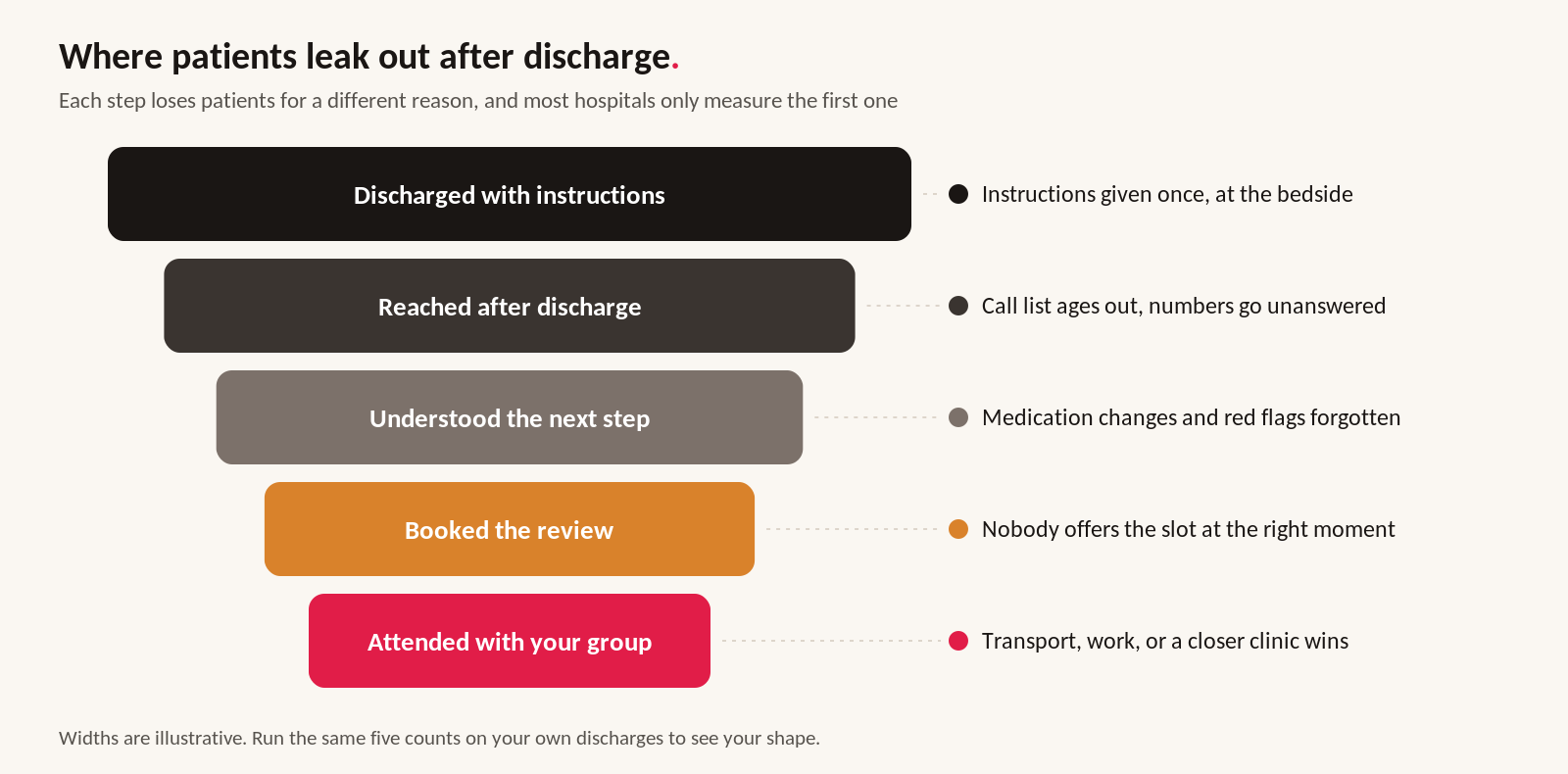
Follow-up after hospital discharge fails at the same five points in almost every service line. Patients leave with instructions.
Then they need to be reached, to understand the next step, to book it and finally to turn up. Each step loses a few more.
The Loss Shows Up Months Later, in Another Group's Appointment Book
Patient leakage after discharge is hard to see because nothing fails loudly. Nobody complains. The patient simply books the physiotherapy, the scan or the next procedure somewhere else, and your records show a review that never happened.
The numbers that do exist are uncomfortable. Fibroblast and Sage Growth Partners surveyed 104 US health system leaders. Of those, 43% estimated they lose more than 10% of revenue to patients going elsewhere.
Some 19% put it above 20%, and 23% could not estimate it at all. GCC groups rarely publish an equivalent figure, which tells its own story.
Timing makes it worse. Kaiser Permanente studied 11,985 heart failure patients. Contact within seven days of discharge was linked to lower odds of readmission within 30 days.
Contact after day seven showed no clear effect. A follow-up that arrives on day ten is not a slightly late follow-up. For many patients it is no follow-up at all.
So how to reduce patient leakage starts with counting it. Pull last quarter's discharges for one service line and count five things. Count patients discharged, patients reached, patients who confirmed the next step, patients who booked it and patients who attended.
The gap between the first and last number is your leakage. The step where it drops fastest is where you start.
Your Call Centre Was Built for Volume, Not for Day Thirty
Most hospitals in the Gulf already run post-discharge calls. The contact centre works through a list of recent discharges for a set number of weeks.
The people on that desk know the doctors, handle exceptions well and speak the patient's language. The problem is arithmetic, not effort.
Here is the sum for one service line. Multiply your monthly discharges by the number of touchpoints in your protocol.
Then multiply by the minutes each completed call takes, including retries and unanswered numbers. Compare that with the hours actually rostered for follow-up.
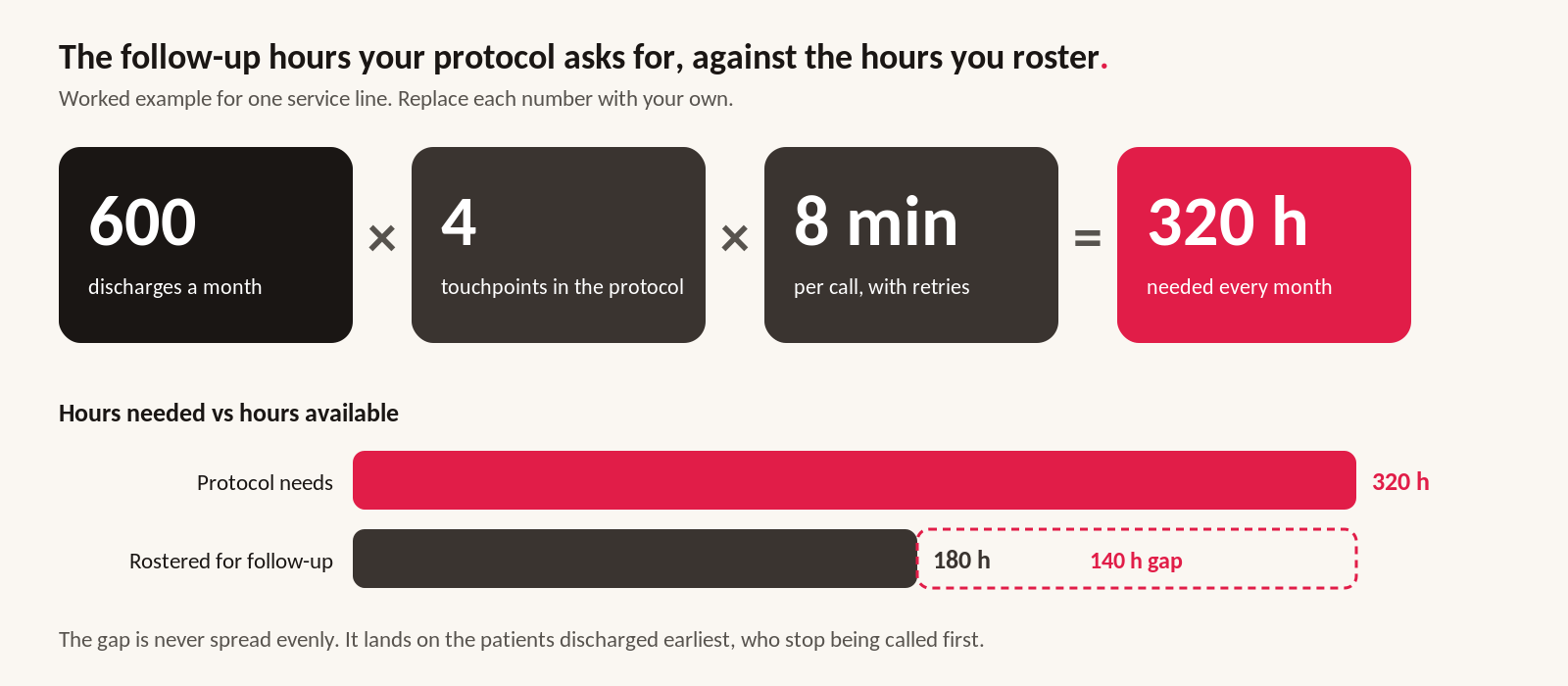
In the worked example above, 600 discharges a month with four touchpoints at eight minutes each needs 320 hours. If the desk has 180 rostered hours for follow-up, 140 hours of protocol simply do not happen.
That gap is never spread evenly. Every new discharge joins the top of the list, so the patients discharged earliest are the first to stop being called.
This is the honest case in the AI agents vs call centre debate. Hiring more agents for the desk closes the gap for a quarter, until volume grows again.
Workforce data points the same way: a 2023 estimate reported by Al Arabiya found Saudi Arabia needs 175,000 more healthcare workers by 2030. Adding headcount to repeatable phone rounds competes with every ward for the same people.
AI agents do not replace the call centre. They take the repeatable part of the list, so the desk spends its hours on the patients who need a person.
A WhatsApp Reminder Is a Message, Not a Follow-Up
Many groups already send reminders from their CRM, often on WhatsApp. It is the channel patients in the UAE and Saudi Arabia use every day, so the instinct is right. The design usually is not.
A CRM reminder goes out and the job ends. Nothing checks whether the patient booked, took the new tablet or turned up.
When a patient replies with a clinical question, it lands in a marketing inbox that no clinician watches. And many older patients, the ones most likely to need follow-up, never open the channel at all.
WhatsApp patient follow-up for hospitals works when the message sits inside a care pathway. The reminder has a goal, the reply is read, a missed step triggers the next attempt, and a worrying answer goes to a nurse. That is the difference between CRM reminders and care pathways.
One sends. The other follows through.
A Protocol-Led Follow-Up Cadence Covers the First 42 Days
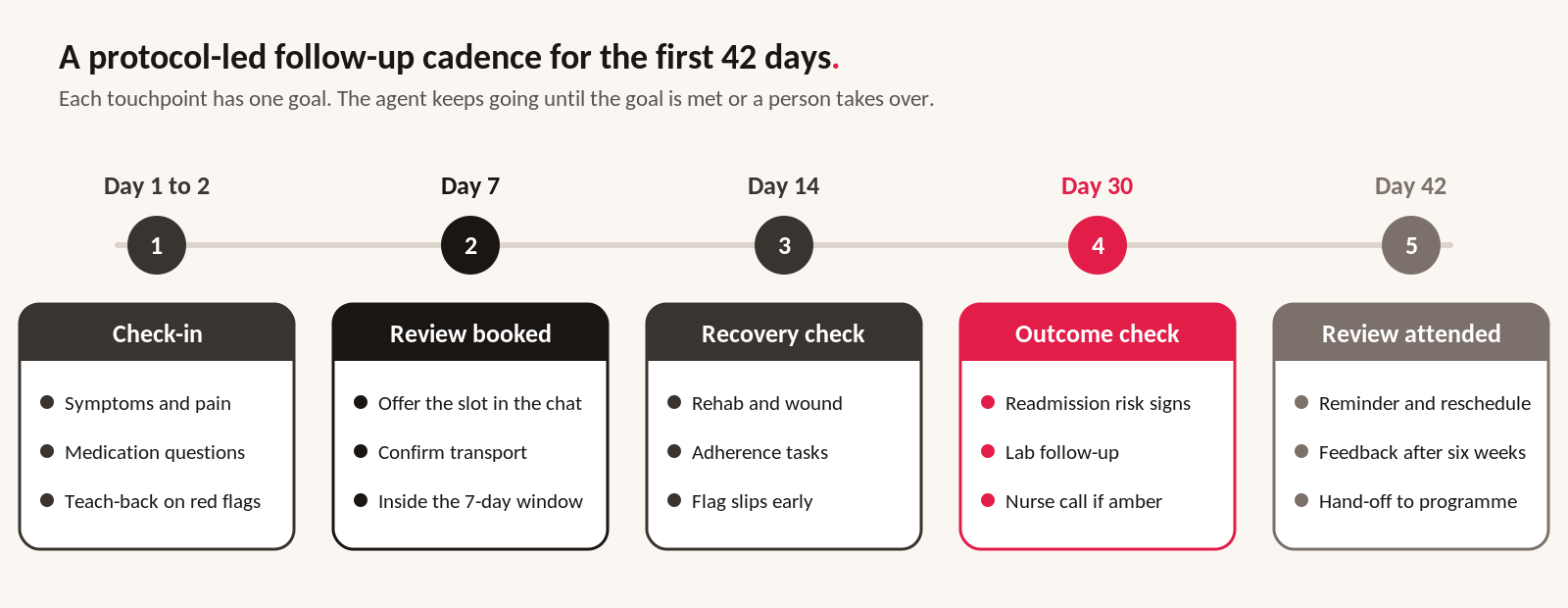
Post discharge patient follow-up best practices come down to one rule. Every touchpoint needs a goal, and the touchpoint is not finished until the goal is met or a person takes over. A "how are you feeling?" message with no goal is noise.
Care transitions are where most of the risk sits, so the cadence is front-loaded. The first contact lands inside 48 hours, and the review is booked inside the seven-day window that the Kaiser Permanente data points to. After that, touchpoints spread out as the patient recovers.
| Goal of the touchpoint | What the agent asks or does | Moves to a person when | |
|---|---|---|---|
| Day 1 to 2 | Patient is settled and understands the plan | Asks about pain, breathing and the wound. Checks the new medicines with a teach-back question. | Any red-flag symptom, or the patient cannot explain the medication change |
| Day 7 | Review booked | Offers available slots inside the chat and confirms transport. | Patient declines twice or asks to speak to someone |
| Day 14 | Recovery on track | Checks rehab tasks, wound healing and adherence against the plan. | Missed doses or rehab sessions on consecutive days |
| Day 30 | Missed doses or rehab sessions on consecutive days | Asks the readmission-risk questions your clinicians set and reminds about lab tests. | Any amber or red answer |
| Day 42 | Review attended and loop closed | Sends the reminder, reschedules if needed and asks for feedback after attendance. | Patient misses the review or reports a poor experience |
Teach-back matters more than it sounds. In an emergency department study, patients asked to explain their instructions in their own words recalled 82.1% of them, against 68.9% with standard instructions.
An agent can ask that question to every patient on day one. A busy ward rarely can.
Red Flags Reach a Nurse Within the Time Your Clinicians Set
High-risk patients are the reason clinical leads hesitate about automation, and they are right to. The answer is not a cleverer agent. It is a stricter one.
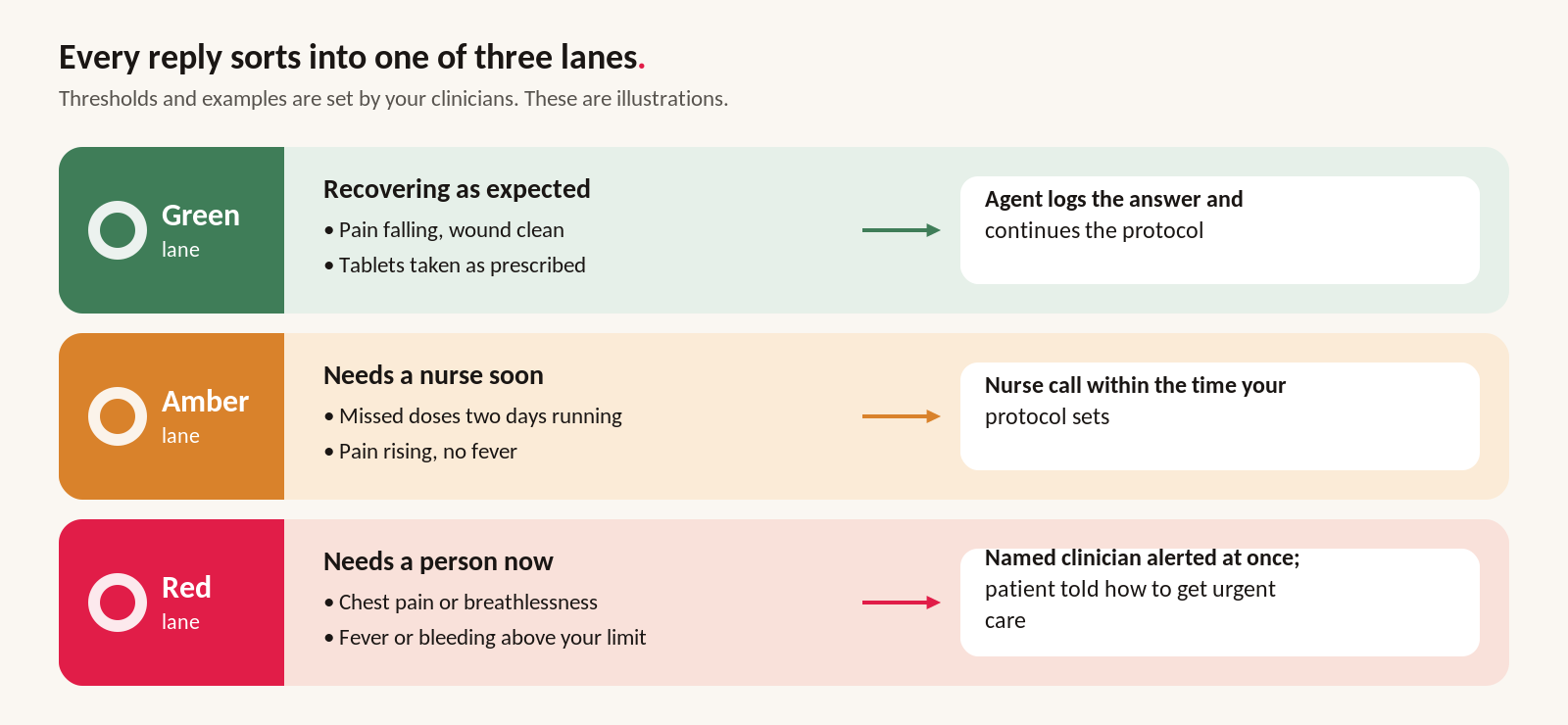
Every reply sorts into one of three lanes. Green means recovery is on track, so the agent logs it and continues. Amber means a nurse should call soon, within a time your protocol defines.
Red means a named clinician is alerted at once and the patient is told how to get urgent care. Your clinicians write the thresholds. The agent never decides that a symptom is fine.
On the Cura42 website, a day-12 exchange shows how this reads to a patient. The agent writes: "Three of your blood pressure readings this week were above your target. Your nurse, Priya, will call you tomorrow at 9 to talk it through."
The patient asks whether to keep taking the evening tablet. The agent answers from the protocol, "Yes, please continue as prescribed", and passes the question to the nurse for the call.
That pattern is the whole design. The patient gets an answer now, from approved material.
The question still reaches a person. And every exchange is written to the record, so the nurse sees the history before she dials.
Agents Take the Repeatable Calls and Your Team Keeps the Judgement Calls
The AI vs nurses for follow-up calls question is the wrong frame. The right one is which calls need a nurse at all.
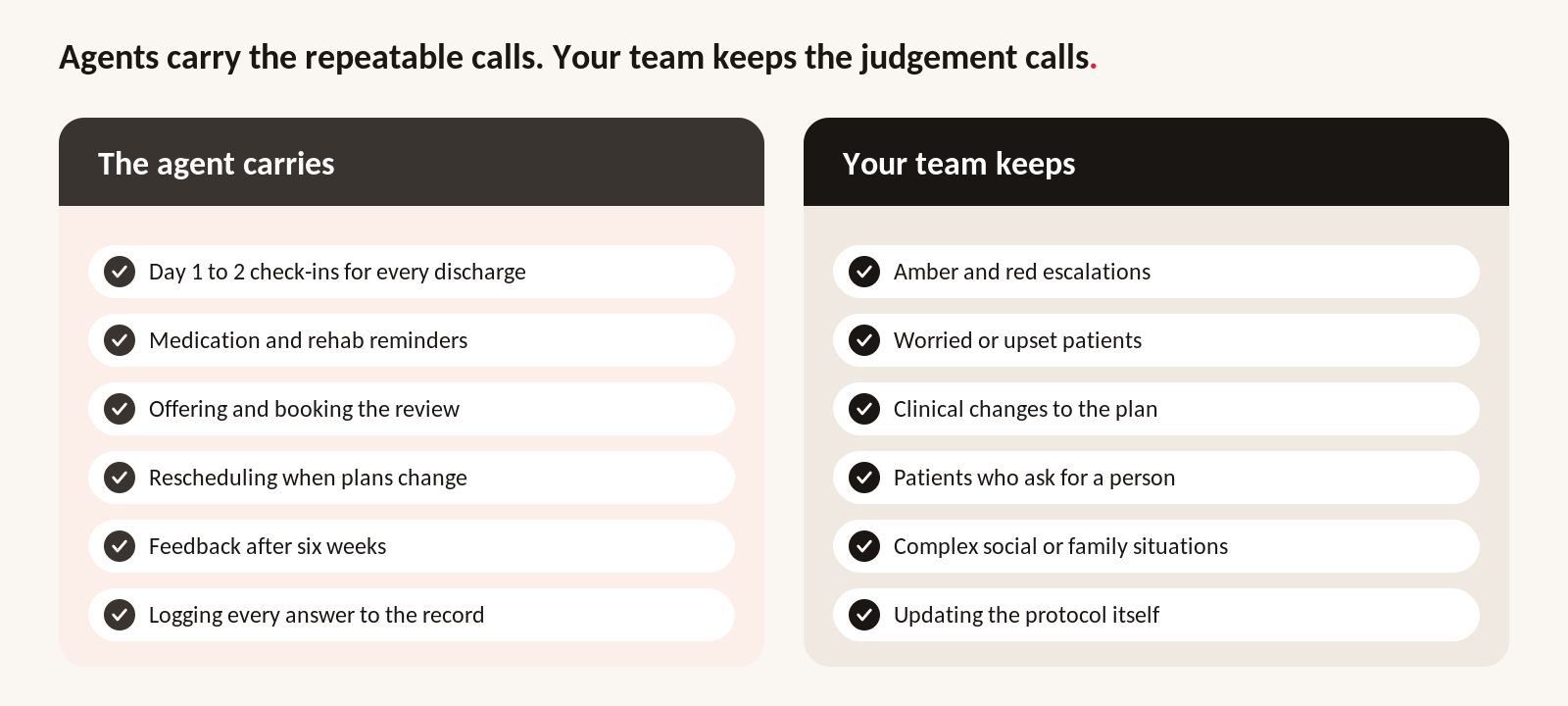
Most of a follow-up protocol is repeatable: day-two check-ins, medication reminders, offering a review slot, rescheduling, feedback. These calls follow a script your clinicians already wrote, and they are exactly the calls that disappear when the roster is short.
The rest needs judgement. A frightened patient, a family situation, a change to the care plan, a patient who simply wants to talk to a person.
When agents carry the first group for every patient, your team has the hours for the second. That is how Cura42 describes the goal: nurses handle the escalations that need a nurse, and the phone rounds are carried for them.
There is a patient experience gain too. Patients notice when a hospital checks on them on day nine.
They tell their families. Satisfaction measured after six weeks of recovery says far more than a survey filled in at the discharge desk.
Building a Follow-Up Tool in-House Ends When the Project Does
Many IT teams in the region have built their own follow-up tool. It usually starts well. The build vs buy patient follow-up tool decision tends to go wrong after go-live, not before.
Clinical guidance changes, and someone has to rewrite the protocol. The clinicians who wrote the original answers move on, and the replies patients see go stale. IT inherits a support queue it was never staffed for, while the project team has already moved to the next priority.
| In-house build | CRM or WhatsApp reminders | Managed AI agent service | |
|---|---|---|---|
| Who writes the protocol | Your clinicians, once | Marketing, as campaigns | Your clinicians, with the vendor's team |
| Who updates it after go-live | Your IT team, when it has time | Nobody, in practice | The vendor, whenever a rule changes |
| Follows up on a missed step | Only if built | No | Yes, until the goal is met |
| Escalates to a clinician | Only if built | No | Yes, by rules your clinicians set |
| What gets reported | Whatever was built | Messages sent | Patients reached, steps completed, one agreed outcome |
| Support after launch | Your IT team | The CRM vendor | Vendor team stays after go-live |
The in-house build vs vendor choice is less about code and more about who owns the protocol in year two. Ask that question first.
Six Numbers Show Whether Follow-Up Is Working
Reducing missed follow-ups starts with replacing the metric most desks report. "Calls made" measures effort.
These six measure outcome. Each one exposes different care gaps, the steps a patient was due to complete but never did.
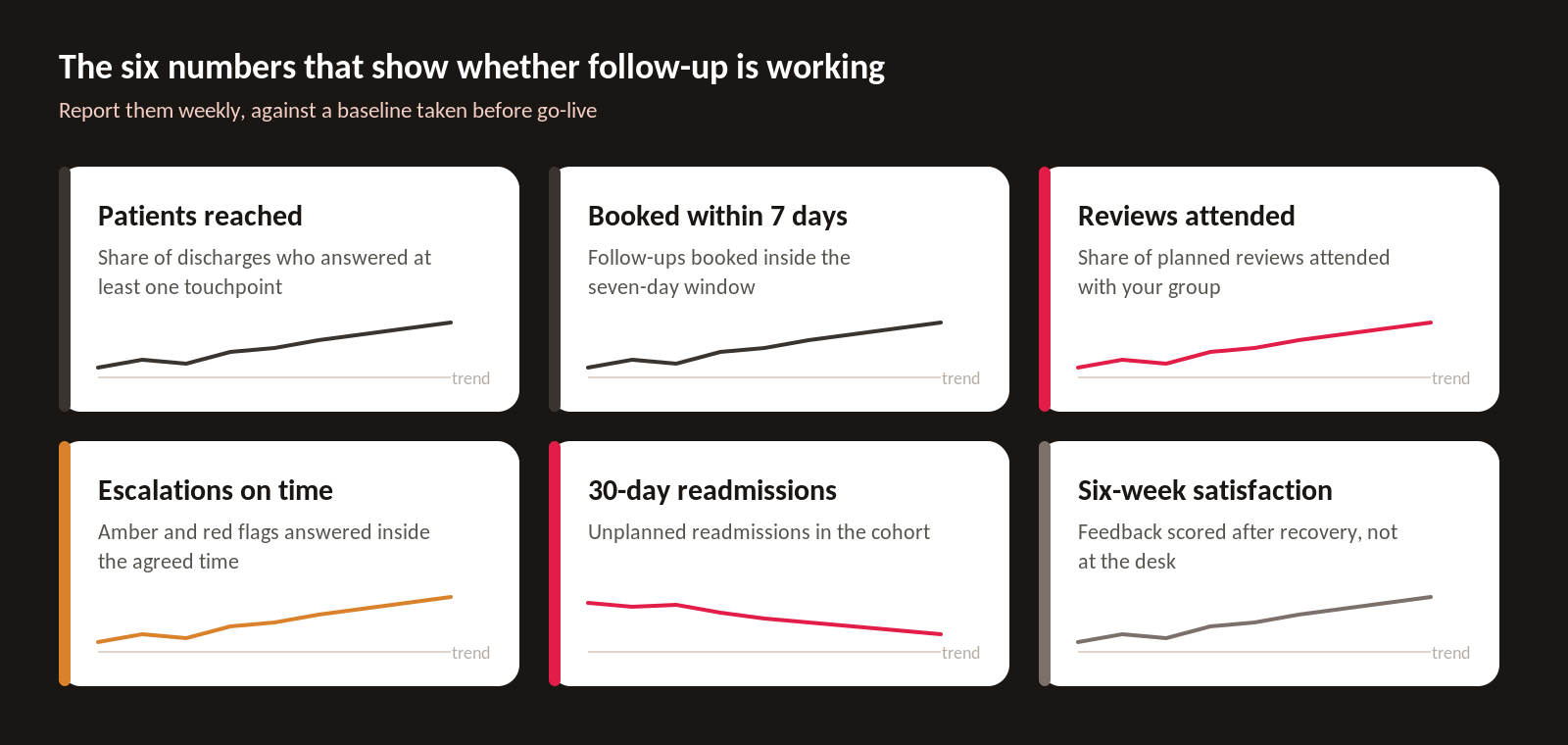
- Patients reached. The share of discharges who answered at least one touchpoint. This is your coverage.
- Booked within seven days. The share of follow-ups booked inside the seven-day window.
- Reviews attended. The share of planned reviews attended with your group. This is where patient retention shows up.
- Escalations answered on time. Amber and red flags handled inside the agreed time. This is your safety number.
- Unplanned 30-day readmissions. Tracked for the cohort, against the same period last year.
- Six-week satisfaction. Feedback collected after recovery, by the same agent that ran the follow-up.
Take a baseline for all six before anything goes live, even if some are rough. A number you cannot find today is the first finding. After go-live, report them weekly and pick one as the number the programme is judged on.
Four People Need to Say Yes Before Go-Live
Most follow-up programmes that stall do so because one of four people joined too late. Get all four in the same room in week one, before any build starts.
The Chief Nursing Officer owns the discharge policy. That policy becomes the protocol the agents run, so they decide what reaches a nurse and what does not. The aim is work taken off the ward, not added to it.
The Chief Medical Officer owns the clinical boundary. They approve every question the agent asks and every green, amber and red threshold. In return they get an audit-ready record of what each patient was told.
The contact centre head owns the hours. They decide which calls move to agents and what the desk does with the time freed up. Today the desk is judged on abandonment and first-call resolution, so add patients reached as well.
The Chief Information Officer owns the connections. They approve what the agents read from the electronic medical record (EMR) and booking system, and where they write back. A read-first set-up keeps the EMR as the official record and keeps the security review short and predictable.
Once those four agree on one service line and one number, the rest is execution. Skip any of them and their concerns will resurface in week six, when they are more expensive to fix.
The First 90 Days Run on One Service Line
Start narrow. Cardiac, diabetes and orthopaedic rehab are good first choices, because the follow-up protocol already exists and the next visit is valuable. Keeping referrals in network is easier to prove on one pathway than on ten.
A first Cura42 deployment follows a short, fixed plan:
- Weeks 1 to 2. Map the pathway with your clinical lead, including every touchpoint, question and threshold.
- Weeks 3 to 6. Build the agents and connect them to your EMR and booking system, reading first and writing back only where your IT team agrees.
- Weeks 7 to 8. Run a supervised pilot with one cohort, with every escalation reviewed by your team.
- Week 9 onwards. Go live and report weekly against the one outcome number agreed up front.
Your EMR stays where it is. Patient data stays under your access rules, with consent and an audit log on every read. The set-up is configured for the rules where you operate.
In the UAE that means DHA, DoH and ADHICS. In Saudi Arabia, SDAIA, the Personal Data Protection Law and NPHIES. Each patient's follow-up history is written to one Patient Longitudinal Record, so the next programme starts with context.