
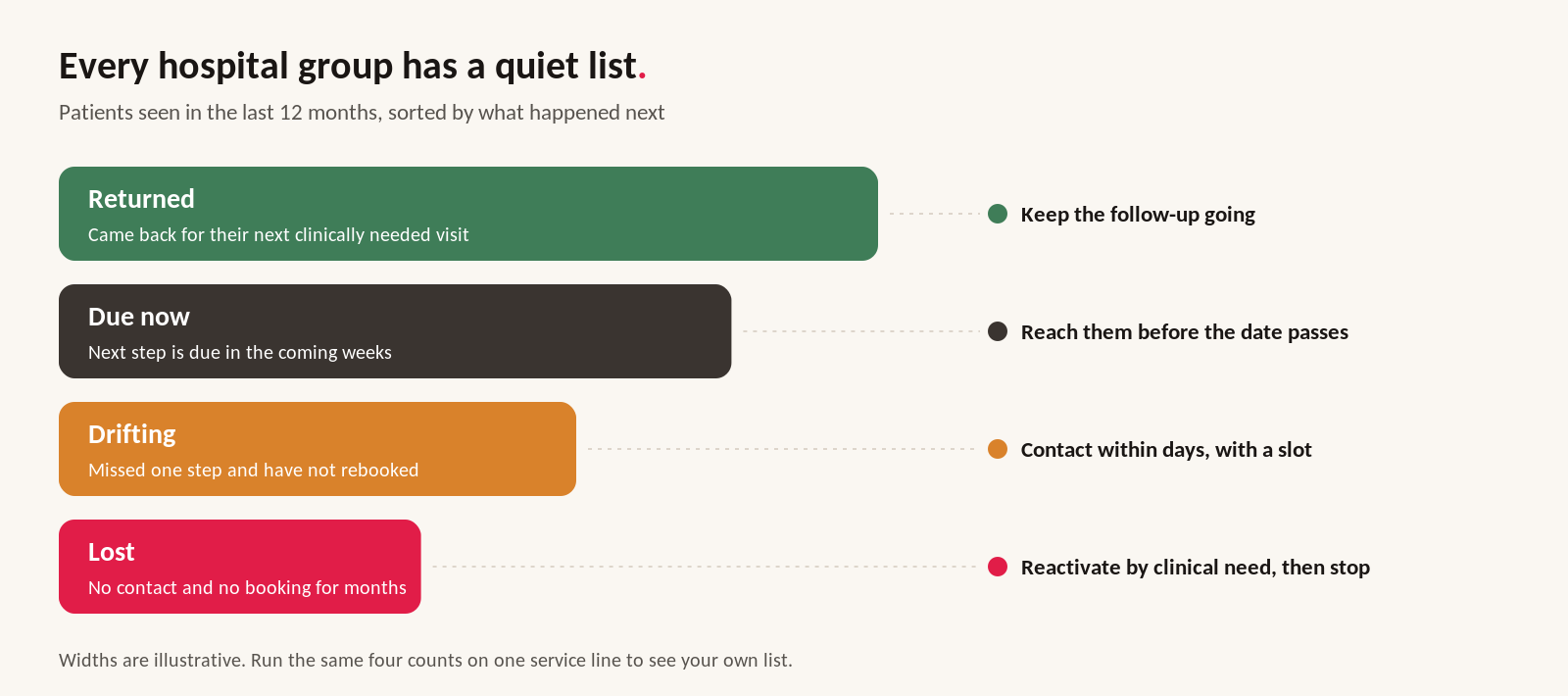
Pull a list from your system of every patient who was told to come back in the last six months. Remove the ones who did.
What remains is your quiet list. Patients with a diabetes review, a post-operative check or a scan that never happened. Nobody complained, so nobody noticed.
Some went to another group. Some went nowhere and are getting worse at home. In both cases, the relationship ended without anyone deciding it should.
This guide explains why patients do not return, seven ways to keep them, and how to win back the patients already on that list.
What Is Patient Retention?
Patient retention is how many of your patients return for their next appointment, test or procedure with your group. It is measured over a set period, usually twelve months.
For a hospital group, it is less about loyalty and more about continuity. A patient who returns for their review is a patient whose care stays on track, with a team that knows their history.
Patient retention vs patient acquisition. Acquisition brings a patient to the first visit. Retention decides whether the second one happens, and the second visit usually costs far less to win.
Why Do Patients Not Return to the Same Hospital?
Most patients do not leave in anger. They leave because nobody told them what came next, or because returning was harder than booking somewhere new.
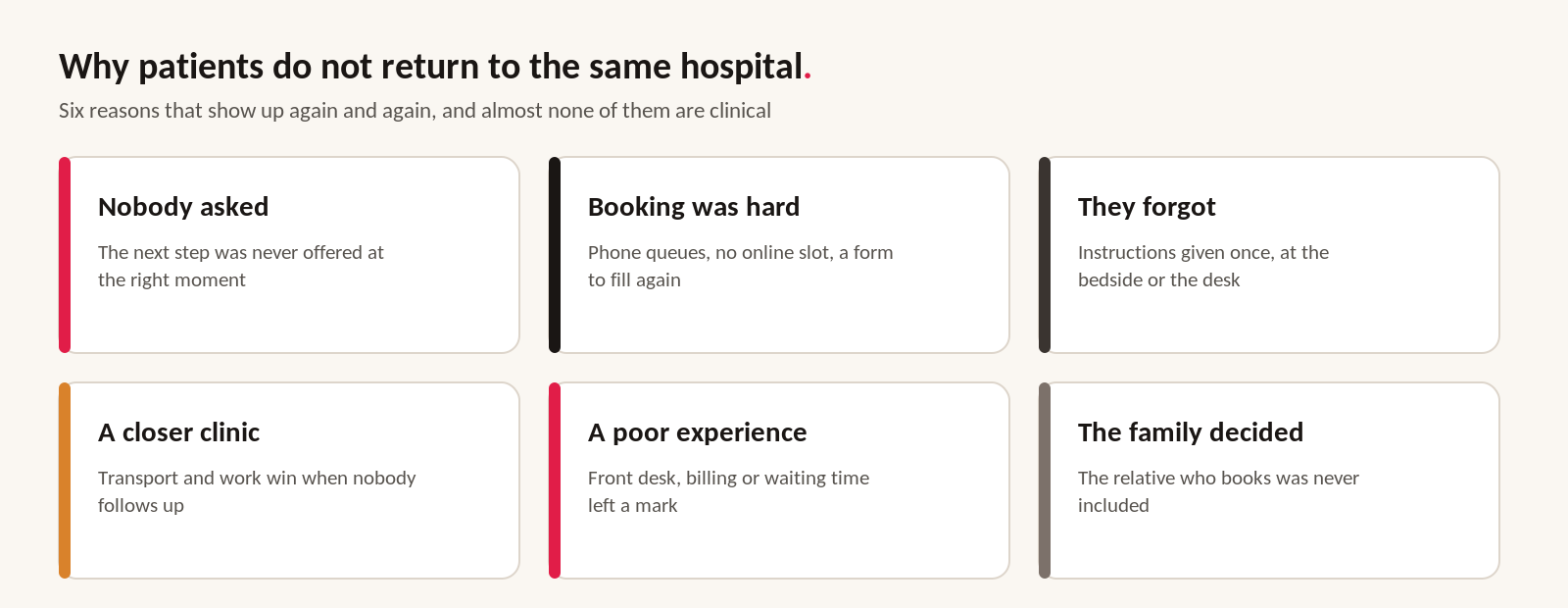
No clear next step. The patient left without a booked review, so "come back in three months" became nothing.
Silence after discharge. No one checked in, so the patient assumed the hospital had finished with them.
Hard to rebook. The phone line was busy and no slot showed online, so another group won the booking.
Starting again each time. The patient told their story at every visit, so the hospital felt like it did not know them.
Cost and coverage changes. A new insurance plan or a price question went unanswered, so the patient followed the network.
Life got in the way. The patient felt better, moved, or travelled home for the summer. With no reminder, the review slipped for good.
Surveys point the same way. In Accenture's 2024 survey of 8,000 US adults, 18% had switched providers after an unsatisfactory experience. Poor front desk contact and digital services that fell short were among the reasons given.
Why Is Patient Retention Important for Hospital Groups?
It is important because the patients you keep are the ones whose care you can follow, and whose next procedure stays with you. Both matter in the Gulf.
Long-term conditions need years of contact. The IDF Diabetes Atlas (2025 edition) puts diabetes at 23.1% of adults in Saudi Arabia and 20.7% in the UAE. Each of those patients needs reviews and tests for life.
Early follow-up protects patients. A Kaiser Permanente study of 11,985 heart failure patients found that a follow-up within seven days of discharge was linked to fewer readmissions. A retained patient is easier to see early.
Patients have choice. In Dubai, Abu Dhabi, Riyadh and Jeddah, a patient can usually book with another private group the same week. The group that stays in touch keeps the booking.
The first visit is the expensive one. Marketing, referral and registration costs land on the first visit. Every return visit spreads that cost further.
What Does the Next Step Look Like by Service Line?
Retention looks different in every service line, because the next step and its timing differ. Write them down for each line before you measure anything.
| Service line | The next step that matters | When it is due | Who owns the follow-up |
|---|---|---|---|
| Cardiology | Post-discharge review and medicine check | Within 7 days, then at 3 months | Cardiology nurse |
| Diabetes programme | HbA1c test and review | Every 3 to 6 months | Diabetes educator |
| Orthopaedic surgery | Wound check and physiotherapy start | Days 10 to 14 | Ward nurse and physiotherapist |
| Maternity | Postnatal check for mother and baby | Within 6 weeks | Midwife |
| Paediatrics | Vaccination schedule | By national schedule | Paediatric clinic coordinator |
| Health checks | Annual repeat check | 12 months | Wellness coordinator |
Once the next step is written down, retention becomes a question you can answer. Did this patient take the step, on time, with your group?
How Do You Improve Patient Retention? Seven Strategies
Each of these patient retention strategies targets a moment when patients decide whether to return. You can start with any one of them on a single service line.
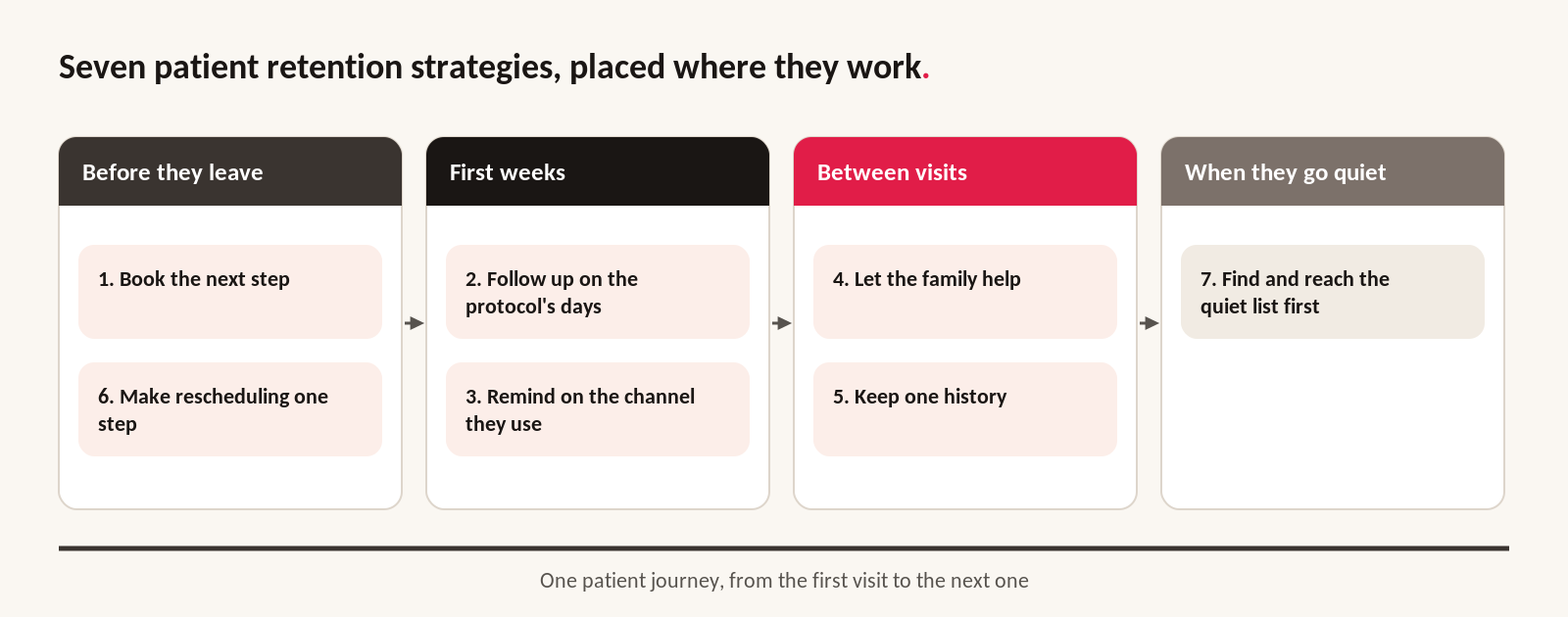
1. Book the Next Step Before the Patient Leaves
A review that is booked before discharge is far more likely to happen than one the patient is asked to arrange. Make "next appointment booked" part of the discharge checklist, not an afterthought.
If the slot cannot be fixed yet, send the booking link within 24 hours. The aim is that no patient leaves with only a verbal instruction.
2. Check in Within the First Week
Contact patients on the days your protocol sets, starting in the first week. Ask about symptoms, medicines and questions, and pass anything worrying to a nurse.
This is the moment patients decide whether the hospital still cares about them. Silence here is where most drift begins.
3. Remind at the Right Time, on the Right Channel
Send reminders on the channel the patient already uses. In the Gulf that is often WhatsApp, with SMS as a fallback.
Systematic reviews of text reminders have found they improve attendance. Time them for when the patient can act: a week before for planning, a day before for the visit.
4. Make Rebooking One Step
Every reminder should carry a way to book or move the appointment. A reminder that ends with "call us to confirm" adds a step, and some patients will stop there.
5. Remember the Patient
Use what the patient has already told you. Greet them in their language, refer to their last visit, and avoid asking for details you hold.
Cura42's Patient Longitudinal Record is designed for this: one connected history per patient across visits, so every message fits the person.
6. Bring the Family In
With the patient's consent, give the relative who books or worries a way to help. A daughter who can see the next appointment is a second reminder that does not depend on your team.
7. Watch the Quiet List Every Week
Run the quiet list as a weekly report, not an annual audit. Sort it by how overdue patients are and how much it matters clinically.
The first name on that list each Monday is the patient most at risk of being lost. Someone should own reaching them.
How Do You Win Back Patients Who Stopped Coming?
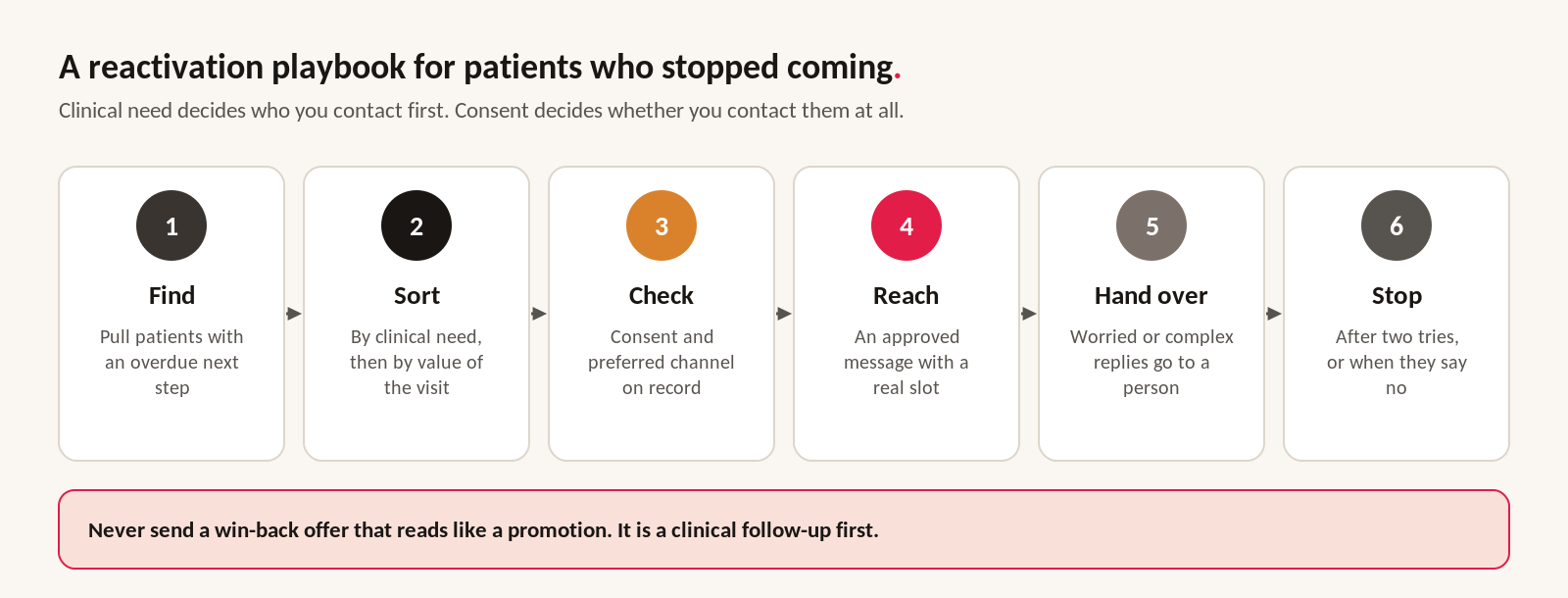
Win back lapsed patients with a short, respectful contact that offers the next step and an easy way to take it. Patient reactivation works best within a few months, before another provider becomes the habit.
| Step | What to do | Watch out for |
|---|---|---|
| Find | Pull patients who were due back and did not book, for one service line | Patients who moved abroad or died; check before contacting |
| Sort | Group by clinical priority and how long they are overdue | Treating a missed scan the same as a missed check-up |
| Check | Confirm consent to contact and the preferred channel | Messaging patients who opted out |
| Reach | Send one short message with the reason and a booking link | Sales language; keep it about their care |
| Hand over | Pass replies with questions or symptoms to a nurse | Leaving replies unanswered over the weekend |
| Stop | Stop after two contacts with no reply and note the outcome | Chasing patients until they block you |
Keep the message plain. "Dr Rahman asked to see you for your three-month diabetes review. Here are three slots this week" works better than any offer.
Three Win-Back Messages That Respect the Patient
Each message below names the doctor, the reason and the next step. None of them mentions an offer or uses pressure.
Send in the patient's preferred language, from a named hospital account. Patients are more likely to reply to a message they recognise than to an unknown number.
If a patient says they have moved to another provider, thank them and close the loop. Ask once, politely, what would have kept them, and record the answer.
Do Loyalty Programmes Work for Hospitals?
A patient loyalty programme rarely brings patients back for clinical care. People return to the hospital that remembered them and made the next step easy, not the one that gave them points.
Programmes can help with elective and wellness services, such as health checks, dental care or physiotherapy packages. For a heart patient or a diabetes review, timely follow-up does more than any reward.
There is also a regulatory question. Health regulators in the UAE and Saudi Arabia set rules on healthcare advertising and on offers made to patients.
How Do You Measure Patient Retention?
Measure retention by service line, over twelve months, and track the steps that lead to it. A single group-wide number hides where patients are leaving.
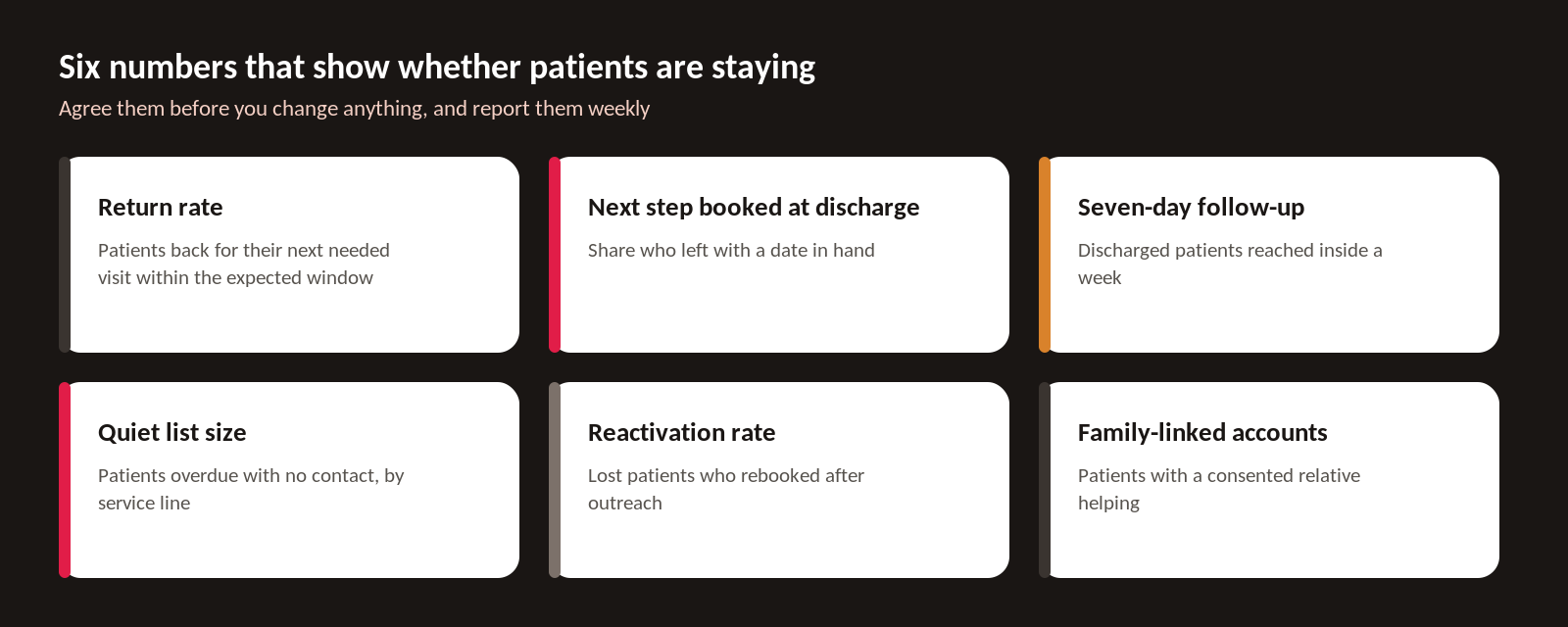
Return rate is the share of patients due back who came back within the agreed window. It is the headline number.
Next step booked at discharge and seven-day follow-up rate show whether the early moments are working. They move before the return rate does.
Quiet list size and reactivation rate show how many patients are drifting and how many you bring back. Family-linked accounts show how many patients have a second person helping them return.
A worked example helps. Say 400 cardiology patients were due a three-month review last quarter and 260 came back. Your return rate is 65%, and your quiet list holds 140 names.
If 90 of those 140 left without a booked review, strategy one is your starting point. If most had a booking and missed it, look at reminders and rebooking instead.
Take a baseline for one service line before you change anything. Report the six numbers monthly to the service line lead and the COO.
What Mistakes Make Patient Retention Worse?
A few common habits push patients away, even when the intention is good. Check your current messages against this list.
- Sending offers instead of care. A discount message to a patient who missed a cancer screening reads as sales, so it gets ignored.
- Messaging too often. Several reminders a week for one appointment train patients to mute you.
- Using one channel only. Email reminders reach few patients in the Gulf. WhatsApp and SMS reach far more.
- Leaving replies unanswered. A patient who replies with a question and hears nothing is less likely to return than one never contacted.
- Counting the wrong number. Message open rates look healthy while the return rate stays flat. Track whether patients came back.
- Waiting a year to look. Annual audits find lost patients too late. A weekly quiet list finds them while they can still be reached.
How Do You Build a Patient Retention Plan in 90 Days?
Build it around one service line and the six numbers above. Three months is long enough to see return rates move.
- Days 1 to 15: baseline. Pull the quiet list, set the next step for each patient group and record today's six numbers.
- Days 16 to 30: set the rules. Agree the follow-up days, messages, channels and escalation routes with your clinical lead.
- Days 31 to 60: switch on. Start booking at discharge, first-week check-ins and reminders with booking links. Run the reactivation playbook on the quiet list.
- Days 61 to 90: review. Compare the six numbers with the baseline. Decide whether to widen the work or adjust the rules first.
Where Should a Hospital Group Start?
Start with the quiet list for one service line. Pull it this week, count it, and pick the first strategy that would have kept most of those patients.
For most groups, that is booking the next step before discharge and checking in during the first week. Both can begin with the systems you already run.
Cura42 is designed to extend your hospital's attention across the whole patient relationship. Its Care Coordination AI Agents follow up on the days your protocol sets and pass anything clinical to your team.