
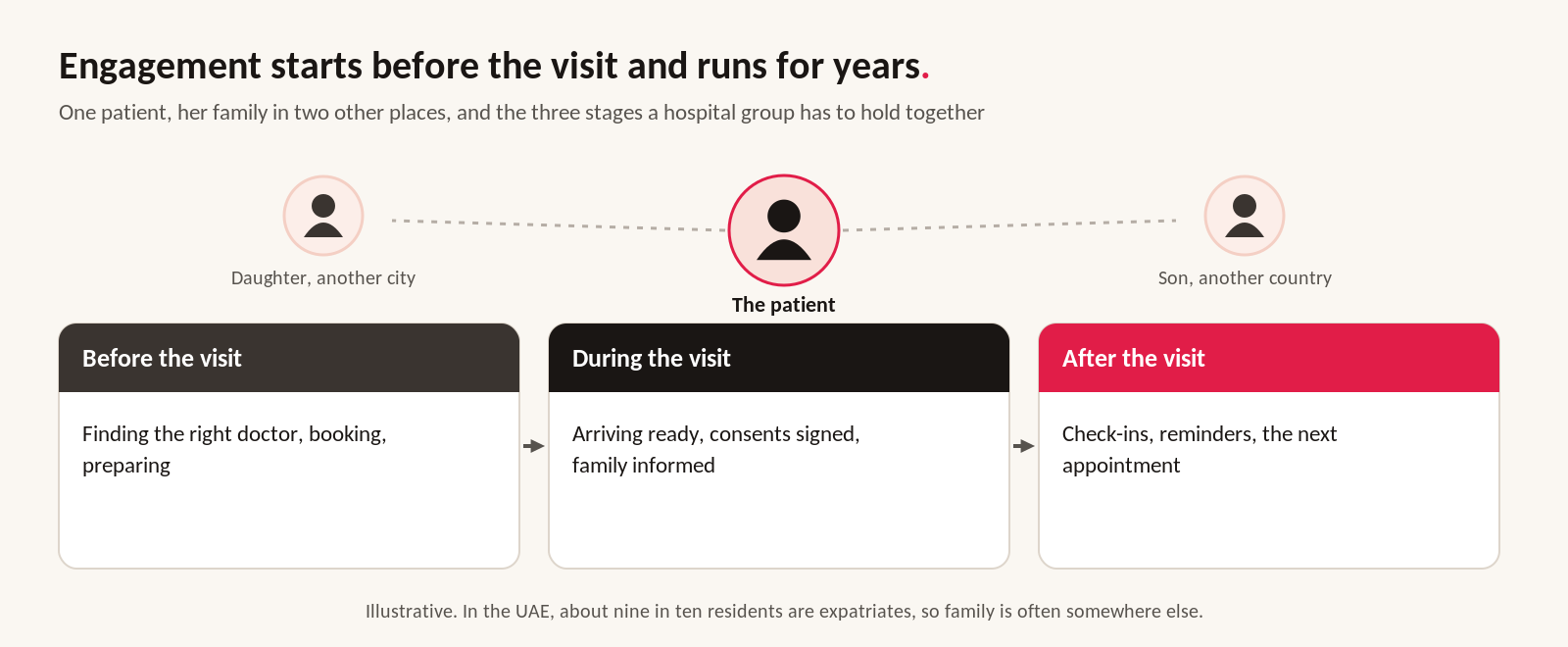
Meet a 64-year-old woman in Dubai with heart failure. Her daughter lives in Abu Dhabi and books most of her appointments. Her son lives in Bengaluru and calls every evening to ask what the doctor said.
When she needs a cardiologist, three people try to reach your hospital. When she goes home after a procedure, three people have questions. If nobody at the hospital answers them, all three remember.
That is patient engagement in a Gulf hospital group. It is rarely one patient and one appointment. It is a family, a relationship that runs for years, and a hospital team trying to keep up with all of it.
This guide explains what patient engagement means in hospital terms, where it breaks, which strategies work, and how to measure it.
What Is Patient Engagement?
Patient engagement is the set of ways a hospital and its patients stay in contact and act together on care. It covers the information a patient receives, the questions they can ask, and the steps they take between visits.
The most cited model comes from Kristin Carman and colleagues, published in Health Affairs in 2013. It describes engagement as a continuum from consultation, to involvement, to partnership.
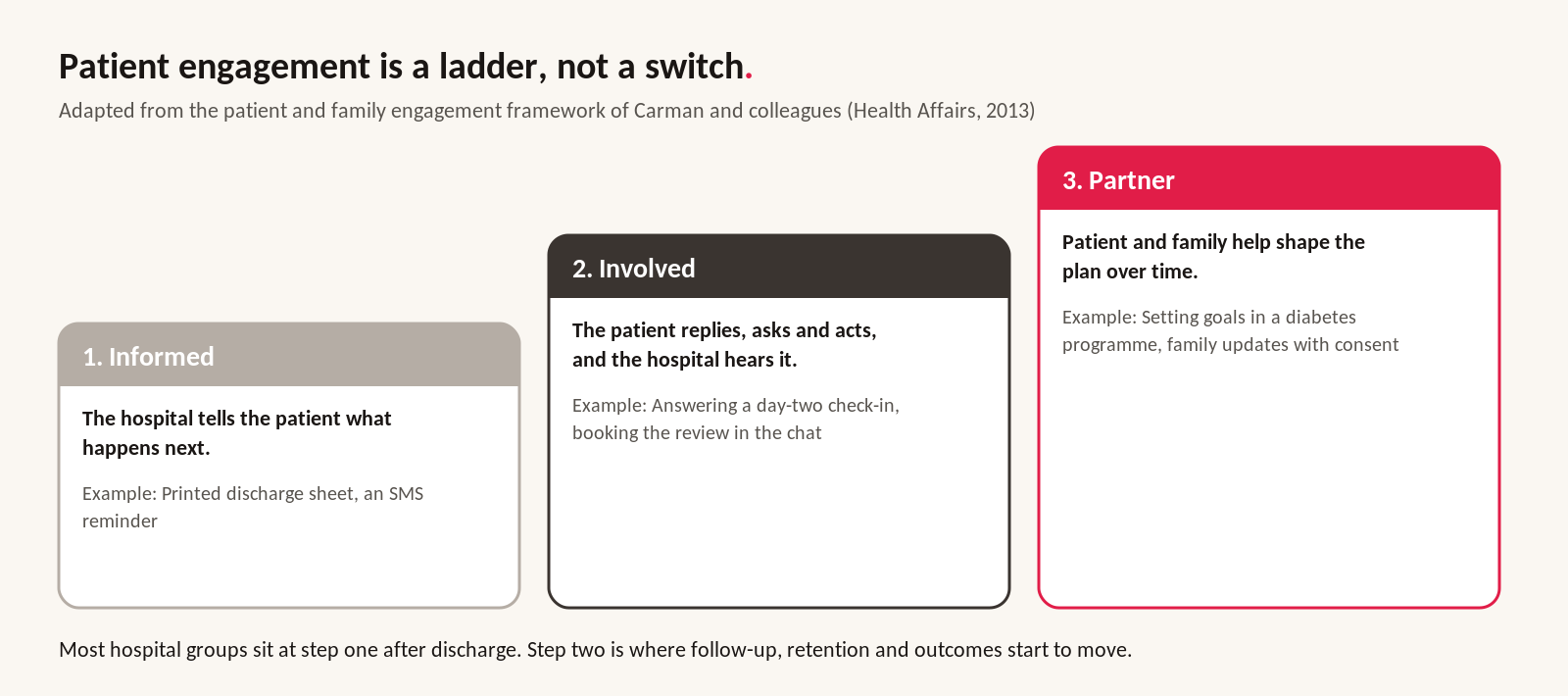
In hospital terms, that ladder has three rungs. At the first, the hospital tells the patient what happens next. At the second, the patient replies, asks and acts, and the hospital hears it.
At the third, the patient and family help shape the plan over months or years. Most hospital groups reach the second rung inside the building and drop back to the first once the patient goes home.
Patient engagement vs patient experience. Patient experience is how the visit felt. Patient engagement is what the patient does next, and whether the hospital helped them do it.
Why Does Patient Engagement Matter for Hospital Groups in the UAE and Saudi Arabia?
It matters because engaged patients do more of the things that keep them well, and they stay with the group that helped them. The evidence points the same way across several measures.
Engaged patients cost less to care for. A Health Affairs study followed more than 32,000 patients at Fairview Health Services in Minnesota. The least engaged had 8% higher predicted costs than the most engaged. The study used the Patient Activation Measure, a licensed survey tool.
Disengaged patients leave. In Accenture's 2024 survey of 8,000 US adults, 18% had switched providers after an unsatisfactory experience. Poor front desk contact and digital services that fell short were among the reasons they gave.
Gulf families stretch the relationship. In the UAE, about nine in ten residents are expatriates, so the relative who books, pays or worries is often in another city or country. Every question they cannot ask online becomes a call your desk takes.
Long-term conditions never end. The IDF Diabetes Atlas (2025 edition) puts diabetes at 23.1% of adults in Saudi Arabia and 20.7% in the UAE. Each of those patients needs reviews, tests and reminders for years.
Regulators measure it. The Department of Health Abu Dhabi (DoH) includes a Patient Happiness domain in its Muashir quality framework. Patients also now expect the access they get from national apps such as Sehhaty in Saudi Arabia and Sahatna in Abu Dhabi.
Where Does Patient Engagement Break Before, During and After the Visit?
Engagement breaks at a different point in each stage, and each break has a cost the group can count. The picture below comes from Cura42's own work with hospital teams.
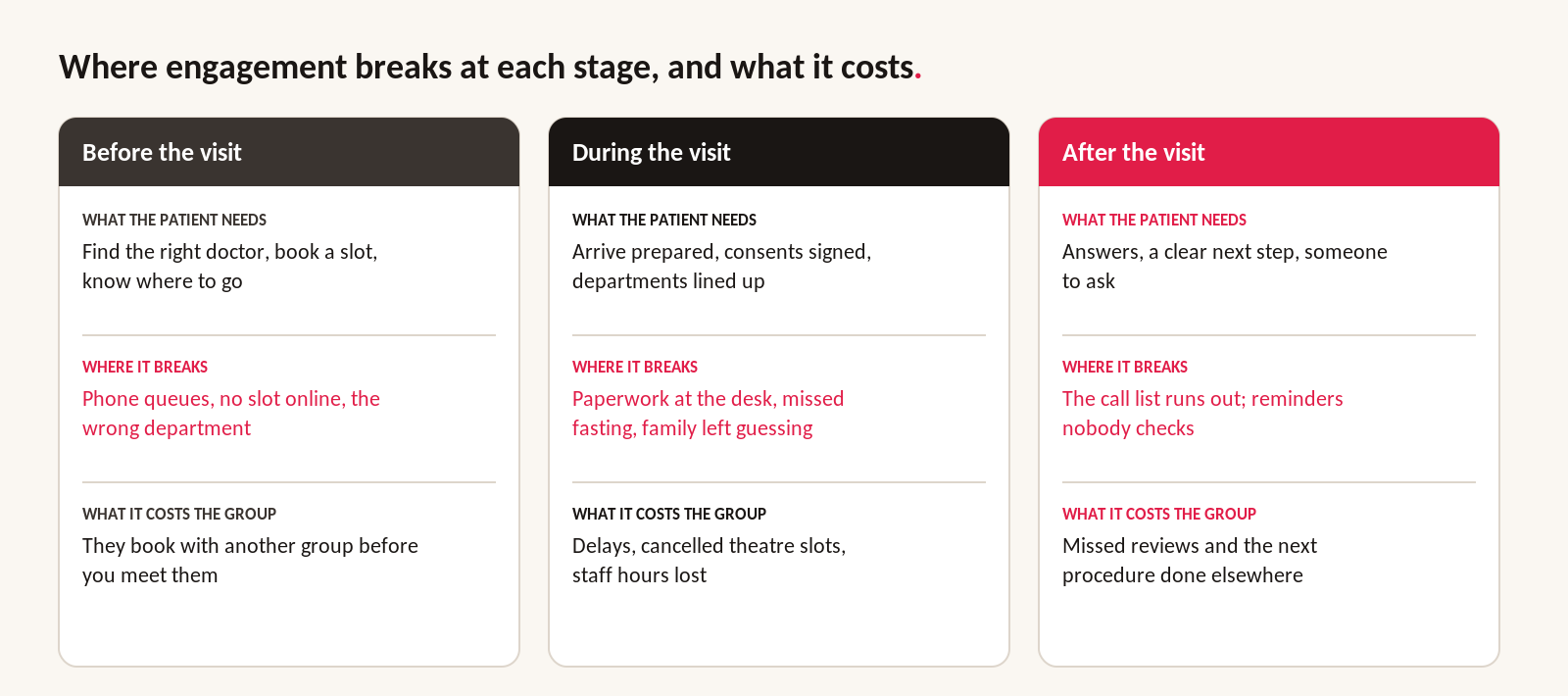
Before the visit, the patient needs to find the right doctor, book a slot and know where to go. When the phone queue is long or no slot shows online, they book with another group before you meet them.
During the visit, they need to arrive prepared, with consents signed and departments lined up. When paperwork starts at the desk, theatre slots slip and staff hours go on forms.
After the visit, they need answers, a clear next step and someone to ask. This is where most groups lose the thread, because follow-up depends on how many people are rostered.
Recall makes the last stage harder than it looks. A review of 51 studies found patients correctly recalled about 47% of emergency discharge instructions given verbally. One conversation at the bedside rarely holds.
What Does Good Patient Engagement Look Like?
Good patient engagement means every patient feels four things at every stage: heard, guided, known and flagged. These are the four promises Cura42 designs around.
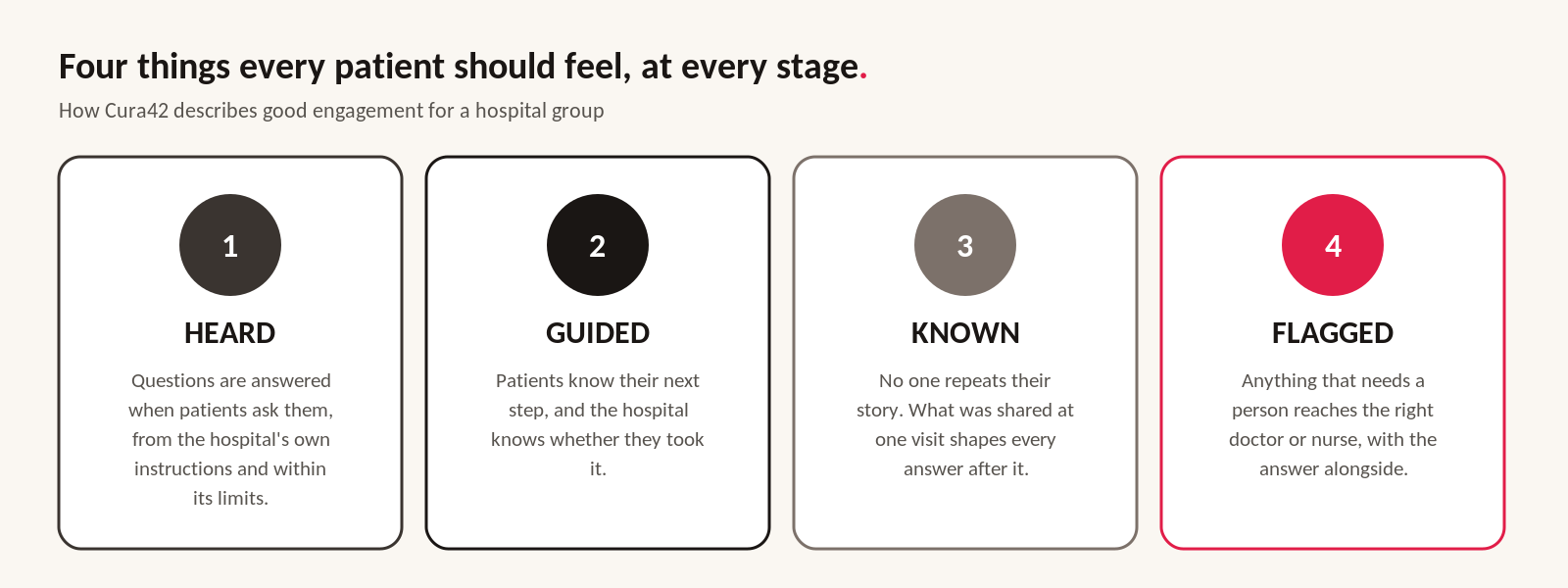
Heard. Questions are answered when patients ask them, from the hospital's own instructions and within the limits it sets. A question at 2 a.m. after discharge gets an approved answer, not silence.
Guided. Patients know their next step, whether that is the way in, preparing for a procedure or the test to book after discharge. The hospital also knows whether they took it.
Known. No one has to repeat their story. What was shared at one visit shapes every answer after it, across departments and sites.
Flagged. Anything that needs a person is passed to the right doctor or nurse, with the answer alongside it. The patient is not left waiting for a callback that may not come.
Which Patient Engagement Strategies Work for Hospital Groups?
Five patient engagement strategies make the biggest difference for groups, and each one can start with a single service line. None of them needs a new core system.
1. Map Every Point Where the Patient Acts Alone
List the moments in one journey where the patient must do something without staff in the room. Fasting before surgery, booking a review and taking a new tablet are typical examples. Each moment is an engagement point, and each one needs an owner.
2. Make the First Move
An app only works when the patient remembers to open it. Engagement starts when the hospital reaches out on the day the protocol sets, on the channel the patient already uses.
3. Answer Only from Approved Instructions
Patients will ask questions in any channel you open. Decide in advance which answers come from approved material and which go straight to a nurse or doctor, and write that down.
4. Bring the Family in, with Consent
Give the relative who books and worries their own way to help, with the patient's permission. They can track the next step and ask questions without phoning your desk.
5. Keep One History Across the Group
When the cardiologist cannot see what the diabetes educator said, the patient becomes the record. One connected history means every answer fits the person asking.
How Do You Communicate Effectively with Patients?
Communicate in short steps, at the moment the patient needs each one, in the language they read best. Most of the work is timing and plain wording, not new technology.
Six habits make the difference in hospital pathways. Each one is small enough to test on a single service line this quarter.
- Say one thing per message. "Stop eating at midnight" lands. A page of fasting, medication and parking advice does not.
- Send it when it matters. Fasting instructions belong in the evening before surgery, not in a leaflet handed over three weeks earlier.
- Use the patient's language. Arabic and English cover most patients, but your catchment may need Hindi, Urdu, Malayalam or Tagalog too.
- Ask them to say it back. Clinicians call this teach-back. A chat can do the same by asking the patient to confirm each step.
- Make the next step one tap. If a message asks the patient to book a test, the slot should be in the message.
- Tell them who to contact. Every message should say what to do if something feels wrong, and how quickly a person will reply.
Where Digital Patient Engagement Fits
Digital patient engagement means doing this work through the channels patients already carry: WhatsApp, SMS, your app and the web. It does not replace the nurse or the desk.
It takes the routine contact off them, so their time goes to the patients who need a person. A PYMNTS Intelligence report from July 2025 found only 36% of US patients use their provider's portal. Reaching patients where they already are matters more than adding a new login.
What Are Good Examples of Patient Engagement?
The best examples are small, specific and timed to the protocol. Here are four from hospital pathways, written as illustrations rather than client results.
| Moment | What the hospital does | What the patient does | What it protects |
|---|---|---|---|
| Three days before a knee replacement | Sends fasting, medication and arrival instructions in Arabic or English | Confirms each step in the chat | The theatre slot |
| Day two after discharge | Asks about pain, the wound and the new tablets | Replies, or asks to speak to a nurse | Early warning of a problem |
| Month four of a diabetes programme | Reminds about the lab test and offers a slot | Books the test from the message | The next review |
| A daughter booking from another city | Gives her family access, with consent | Books and tracks the appointment herself | Desk time and the family's trust |
How Do You Measure Patient Engagement?
Measure what patients do, not what the hospital sends. Message counts and app downloads tell you about activity, not engagement.
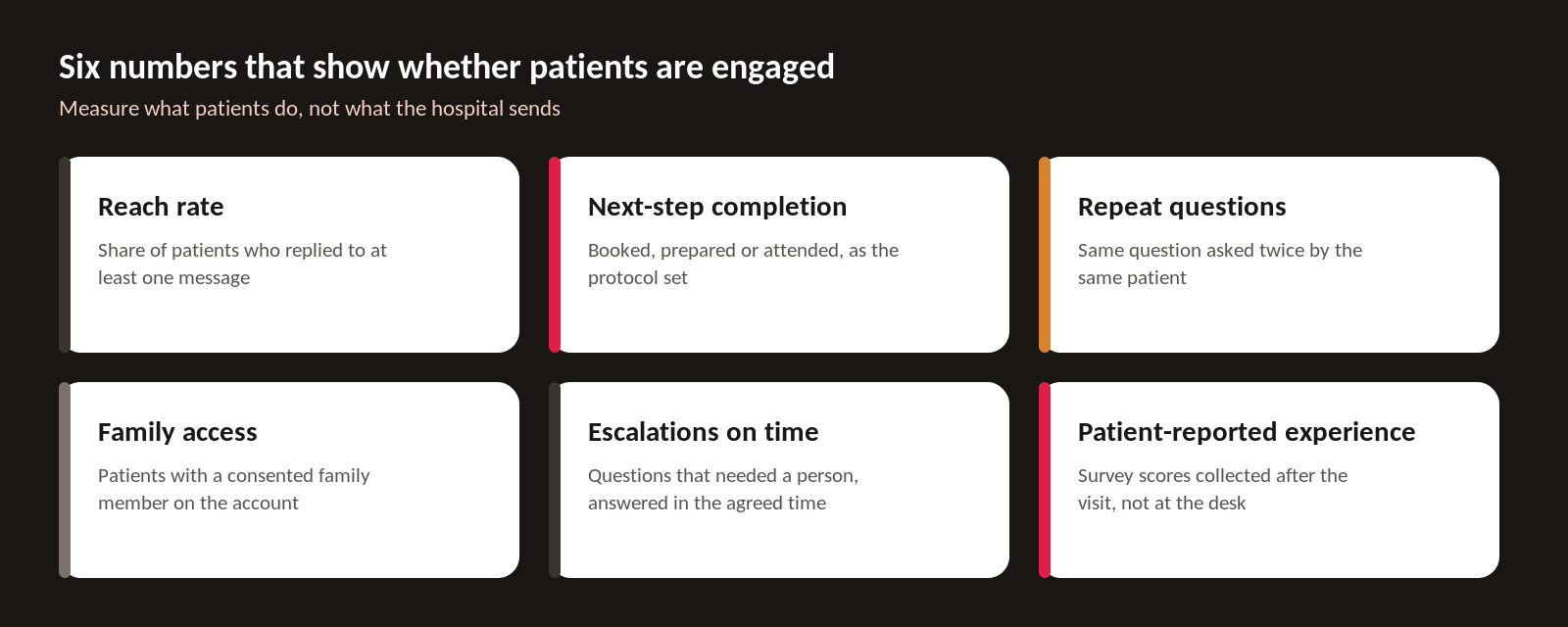
Start with six numbers. Reach rate and next-step completion show whether patients act. Repeat questions and escalations answered on time show whether they were heard.
Family access shows whether the people around the patient can help. Patient-reported experience, collected after the visit through a survey your regulator accepts, shows how it felt.
Take a baseline for one service line before you change anything. A number you cannot find today is the first finding.
Who Should Own Patient Engagement in a Hospital Group?
One named person should own it for each service line, with the COO holding the group number. When engagement belongs to everyone, the gap after discharge belongs to no one.
In most groups the work is split today. Marketing owns the app, the contact centre owns the phones, nursing owns discharge, and IT owns the integrations. Each team does its part well, so the handovers between them are where patients drop.
| Role | What they own | The number they watch |
|---|---|---|
| Chief operating officer (COO) | The group engagement number and the budget | Next-step completion across service lines |
| Service line lead | The journey map and the engagement points | Reach rate and return visits for that line |
| Chief nursing officer (CNO) | Escalation rules and approved instructions | Escalations answered on time |
| Contact centre head | The calls that should not need to happen | Repeat questions per patient |
| Chief information officer (CIO) | Connections to the electronic medical record (EMR) and booking | Share of messages sent from live data |
Write the map down and share it. When a patient falls between two teams, the map tells you who picks them up.
How Do You Start in the Next 30 Days?
Start with one service line, one gap and one number. A group-wide programme can wait until the first line shows a result you trust.
- Week 1: choose the line. Pick a service with a clear next step, such as orthopaedic surgery, cardiology follow-up or a diabetes programme.
- Week 2: map and baseline. List every point where the patient acts alone. Pull today's numbers for reach, next-step completion and repeat calls.
- Week 3: write the rules. With your clinical lead, agree the approved instructions, the escalation triggers and who answers each one.
- Week 4: switch on and report. Reach patients on the agreed days and compare the first report with your baseline.
At the end of the month you will know two things. You will see how big the gap really is, and whether patients respond when the hospital makes the first move.
This is general information, not legal advice. Confirm current requirements with your regulator and legal team.
What Is Patient Engagement Not?
It is not a marketing campaign, a loyalty points scheme or a higher number of app downloads. Those can support engagement, but none of them checks whether the patient took their next step.
It is also not a replacement for clinicians. Good engagement takes the repeatable contact off your team, so their hours go to the patients who need a person.
Cura42 is designed to extend your hospital's attention across the whole patient relationship. It works through three service lines: Digital Front Door, Care Coordination AI Agents and the Patient Longitudinal Record.